Introduction
Although Singapore Changi Airport is a destination in its own right, travelers with a layover longer than 6 hours are strongly encouraged to step outside the airport and explore the city itself.
Singapore is one of the few cities in the world where even a short layover can turn into a real journey. The city offers an exceptionally efficient public transport system, clear navigation, a high level of safety, and a compact city center — making it possible to see a lot in just a few hours.
With 6–8 hours of free time, you can already feel the atmosphere of Singapore, see its main highlights, and return to the airport without rushing. If your layover is closer to 12 hours, you can add museums and indoor conservatories or simply spend more time exploring each area at a relaxed pace.
Below is a well-planned walking itinerary through Singapore, perfectly suited for a 6–12 hour layover, designed to show the city at its very best.
How to Get from Singapore Airport to the City Center 🛫
MRT from Changi Airport
MRT (metro) is a convenient option for travelers who prefer public transport. Changi Airport MRT Station is located directly inside the airport, on the basement level between Terminals 2 and 3.
You can pay using a contactless bank card or purchase a Singapore Tourist Pass, available at ticket machines near the metro entrance.
Taxi from Singapore Airport
If you prefer a taxi, the easiest option is to use the Grab app. This option is usually faster than the metro, though slightly more expensive. The ride to the city center typically takes around 20 minutes, depending on traffic.
Location 1: Chinatown — Where Singapore Began 🏮
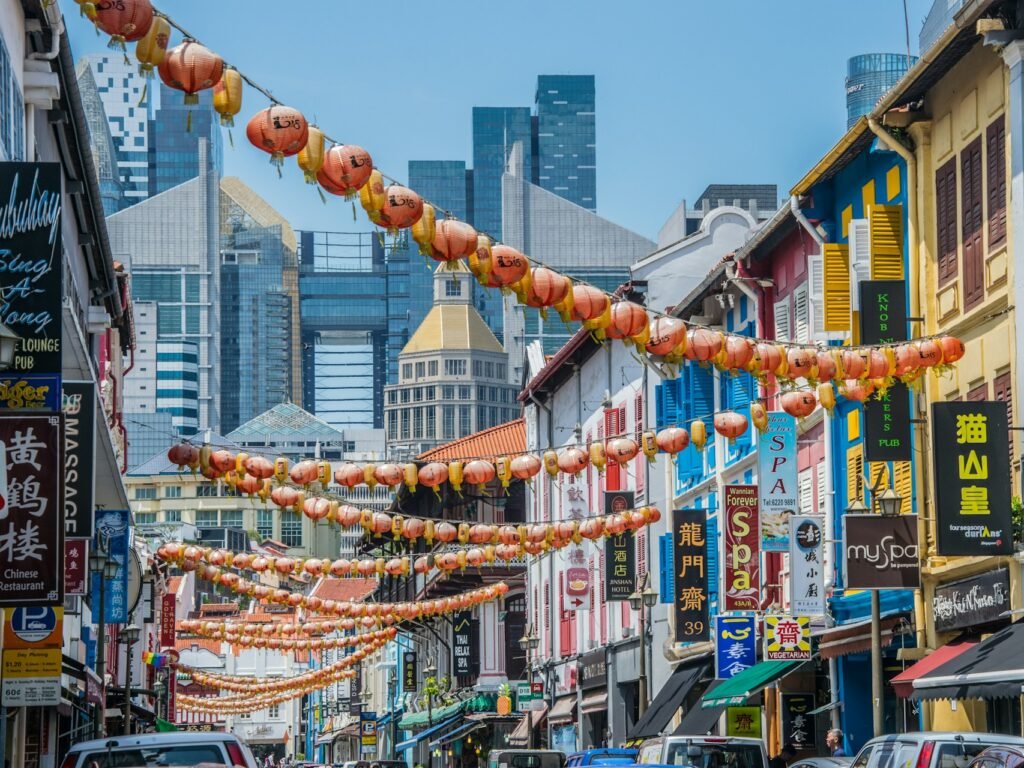
The history of Chinatown in Singapore
Chinatown is an ideal starting point for this route. Its history is closely tied to the British colonial period that began in 1819, when Singapore became an important trading port of the British Empire.
The colonial administration actively encouraged immigration from China to support the rapidly growing port and trade routes connecting Europe, India, and China. Most Chinese immigrants came from Fujian and Guangdong provinces and settled close to the docks for practical reasons — it was easier to find work as port laborers, traders, or intermediaries.
During the colonial era, Chinatown developed as both a residential and commercial district. Shophouses combined shops, warehouses, and living quarters under one roof, with entire families often living upstairs. At the time, even opium dens were legally operated here, reflecting the complex and often harsh realities of early immigrant life.
British policies of ethnic-based urban planning ultimately cemented this area’s status as Chinatown, which over time became the cultural and historical heart of Singapore’s Chinese community.
Why Chinatown is worth visiting
Chinatown is especially appealing to travelers who want to see Singapore beyond its skyline of glass and steel. It offers a glimpse into the city’s everyday life and cultural roots. Descendants of the first Chinese immigrants still live here, family-run shops and traditional medicine stores continue to operate, and religious festivals remain part of daily life rather than staged performances for tourists.
Chinatown is often described as the “real” Singapore because of its rare concentration of cultures within a small area. Buddhist temples, a Hindu temple, a mosque, colonial-era shophouses, and modern buildings coexist within just a few blocks.
Street food and markets here are still largely oriented toward locals: office workers from nearby districts come for lunch, retirees stop by for familiar dishes, and prices reflect everyday life rather than tourist expectations.
Chinatown is not an open-air museum — it is a living neighborhood where history is seamlessly woven into the rhythm of the modern city.
Route: Walking through Chinatown
Starting point: Maxwell MRT Station
Exiting at Maxwell MRT Station is a convenient way to begin the route. This is where the journey through Singapore starts, gradually drawing you into the city’s history.
🚆 Travel time from the airport by MRT: ~1 hour
🚕 Travel time by taxi (instead of MRT): ~25 minutes
Buddha Tooth Relic Temple
One of the most prominent landmarks in Chinatown, the Buddha Tooth Relic Temple is an important religious center. Although it was completed in 2007, its architecture is inspired by the Tang Dynasty.
According to tradition, the temple houses a sacred relic — a tooth of the Buddha. Even if you are not particularly interested in religion, the richly decorated interiors, small museum, and peaceful rooftop garden make this a worthwhile stop and a welcome break from the busy streets outside.
🚶♂️ Walking time: 1 min
⏱ Time needed: ~20 min
📍 Google Maps: Buddha Tooth Relic Temple
Chinatown Complex Hawker Centre
Opened in the 1980s as part of a government program to organize street food vendors, Chinatown Complex Hawker Centre is one of the best places to experience authentic Singaporean cuisine.
This massive indoor food court caters primarily to locals and is home to dozens of affordable stalls, including the famous Michelin-starred chicken rice vendor. Having a meal here is an essential part of getting to know the neighborhood.
🚶♂️ Walking time: 1 min
⏱ Time for lunch: ~40 min
📍 Google Maps: Chinatown Complex Hawker Centre
Chinatown Heritage Centre
Located inside restored shophouses, the Chinatown Heritage Centre offers insight into the living conditions of Chinese immigrants in the 19th and early 20th centuries.
The exhibition recreates cramped rooms, shared kitchens, and multi-generational households, helping visitors understand how the district — and modern Singapore — took shape.
🚶♂️ Walking time: ~3 min
⏱ Time needed: 30–60 min
📍 Google Maps: Chinatown Heritage Centre
Pagoda Street
Take a walk along Pagoda Street, the main shopping street in Chinatown, lined with souvenir shops and colorful two-story shophouses. It is one of the most recognizable streets in the area and remains lively throughout the day.
Historically, Pagoda Street was home to worker dormitories and small businesses. Today, it retains its original layout and the atmosphere of an old trading quarter.
🚶♂️ Walking time: — (you are already here)
⏱ Time needed: ~15 min
📍 Google Maps: Pagoda Street
Sri Mariamman Temple
The Sri Mariamman Temple is Singapore’s oldest Hindu temple, founded in 1827 by the Tamil community. For many years, it served not only as a place of worship but also as a refuge for newly arrived immigrants.
The temple is easily recognizable by its colorful gopuram, adorned with dozens of deities and mythological figures. Its proximity to Buddhist temples highlights the cultural diversity that defines Chinatown.
🚶♂️ Walking time: 1 min
⏱ Time needed: ~15 min
📍 Google Maps: Sri Mariamman Temple
Time summary for Chinatown
- Minimum: ~1.5 hours
(no museum visit or a quick meal) - Comfortable: ~2 hours
(with a short museum visit) - Relaxed pace: ~3 hours
(leisurely lunch and museum visit)
If you want to start the route here
🚕 Taxi drop-off: Buddha Tooth Relic Temple
🚇 Nearest MRT station: Maxwell MRT
(Downtown Line – Brown)
Location 2: Scenic Walk to Marina Bay — The Iconic Postcard View 🌊
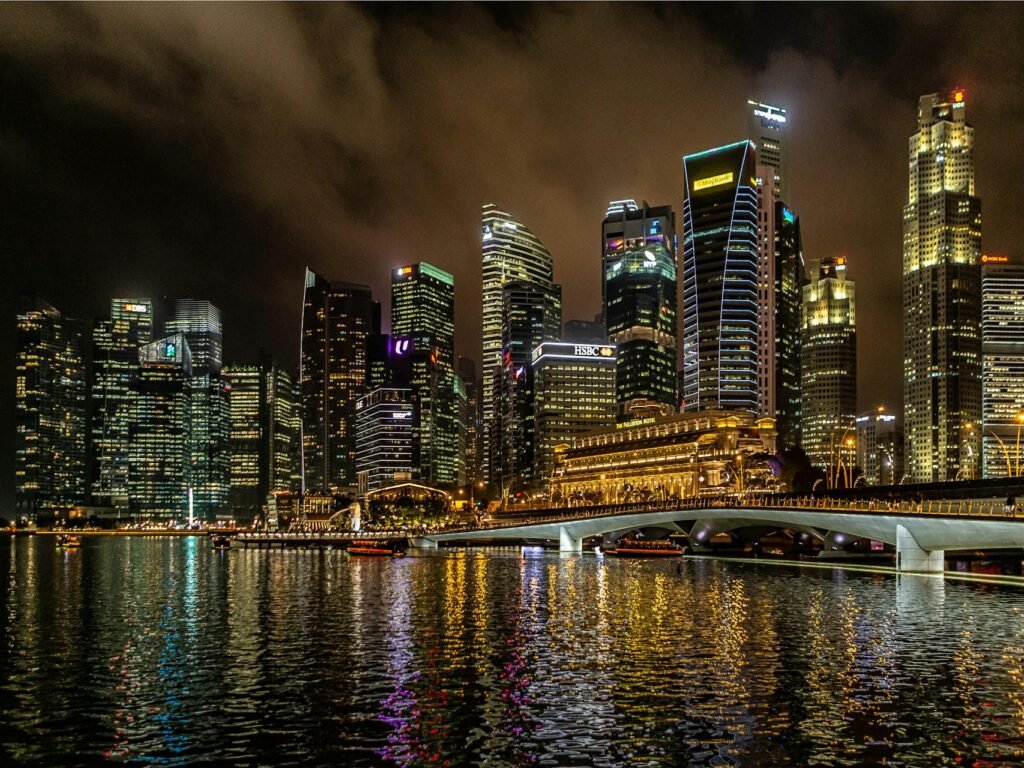
From historic Chinatown to futuristic Marina Bay
The walk from Chinatown to Marina Bay tells the story of Singapore’s transformation better than any museum. In just a few kilometers, you move from 19th-century immigrant quarters to a district built on reclaimed land at the turn of the 21st century.
What was once a working harbor with warehouses and docks is now one of Asia’s most recognizable cityscapes — a place where water, glass, steel, and light define the modern image of Singapore.
This stretch of the route is not just a transition between locations. It is a destination in itself, offering some of the most iconic views of the city.
Jubilee Bridge
The Jubilee Bridge is a pedestrian bridge opened in 2015 to commemorate Singapore’s 50th anniversary of independence. It connects the historic Civic District with Marina Bay and symbolically marks the country’s journey from its colonial past to an independent global city.
From here, the skyline of Marina Bay opens up dramatically. The combination of water, modern architecture, and open space makes this one of the best spots for your first panoramic photos of the bay — especially in the late afternoon or early evening.
🚶♂️ Walking time to the bridge: ~20 min
⏱ Time on the bridge (photos included): ~10 min
📸 Best shots: Marina Bay skyline and reflections on the water
📍 Google Maps: Jubilee Bridge
Waterfront Promenade
The Waterfront Promenade runs along the edge of the former harbor, where trading ships once docked in the 19th and early 20th centuries. Today, it is one of the most pleasant walking areas in central Singapore.
Designed specifically for pedestrians, the promenade features wide paths, open sightlines, and uninterrupted views of the bay. This is the stretch where many of the classic “Singapore postcard” photos are taken — the city rising directly from the water.
Walking here feels calm and spacious, even though you are in the heart of a major global city.
🕘 Time for walking and photos: ~10 min
📸 Best shots: skyline views, water-level perspectives, city reflections
📍 Google Maps: Waterfront Promenade
Time summary: Chinatown → Marina Bay walk
- Minimum: ~40 minutes
- Comfortable pace: ~1 hour
If you want to start the route from this location
🚕 Taxi drop-off: The Esplanade
🚇 Nearest MRT station: Raffles Place MRT
(North–South Line – Red, East–West Line – Green)
This option works well if you want to skip Chinatown and begin directly with the most photogenic part of the route.
Location 3: Marina Bay — Architecture of the Future 🌃
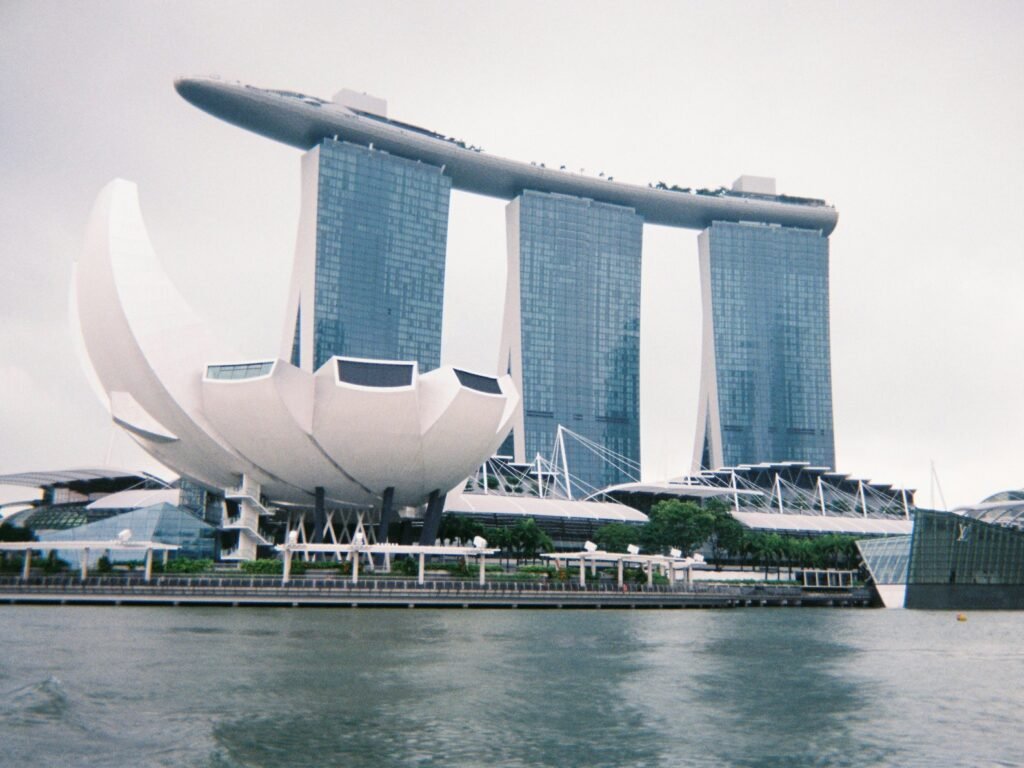
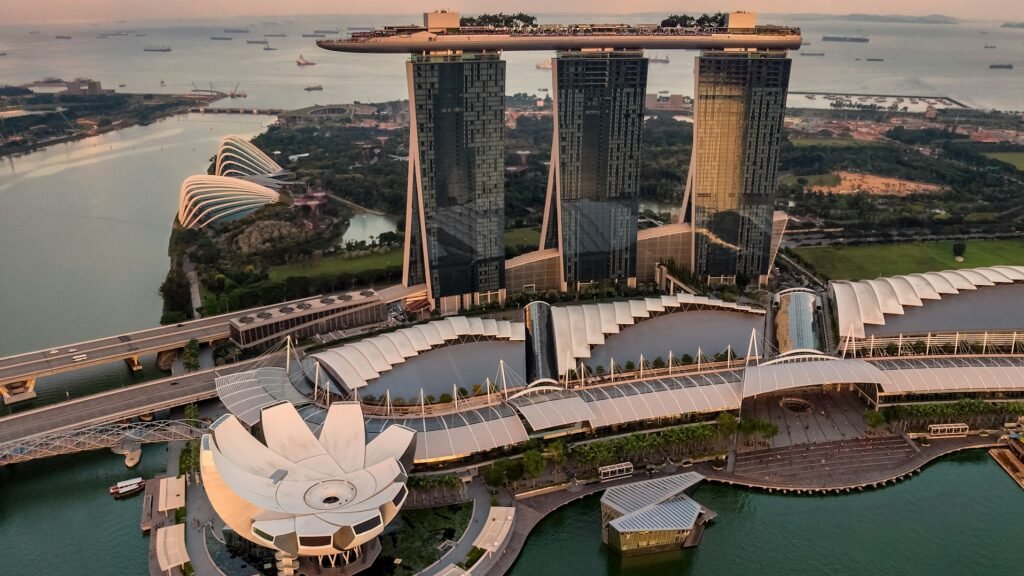
Marina Bay is the showcase of modern Singapore. This district was created on reclaimed land and designed as a symbol of the city’s next stage of development — confident, global, and forward-looking.
Here, architecture becomes part of the urban experience. Water, open public spaces, futuristic bridges, and iconic buildings form a carefully curated landscape that feels both monumental and accessible. Marina Bay is especially impressive in the evening, when lights turn the entire area into a living city-scale installation.
Helix Bridge
The Helix Bridge is one of Singapore’s most recognizable pedestrian bridges. Opened in 2010, its design is inspired by the structure of DNA, symbolizing life, continuity, and progress — themes central to Singapore’s national narrative.
Crossing the bridge offers some of the best views in the city: Marina Bay Sands on one side, the ArtScience Museum on the other, and the illuminated skyline reflected in the water. After sunset, the bridge itself becomes a glowing architectural sculpture.
🕘 Time on the bridge (with photos): ~10 min
📸 Best shots: Marina Bay Sands, skyline lights, reflections after dark
📍 Google Maps: Helix Bridge
ArtScience Museum (outside view)
The ArtScience Museum is one of Marina Bay’s architectural icons. Shaped like a lotus flower, the building symbolizes the intersection of art, science, culture, and technology — core pillars of Singapore’s vision for the future.
Opened in 2011, the museum hosts large-scale interactive and multimedia exhibitions. Even if you do not go inside, the exterior alone is worth a stop. The museum is especially photogenic from the waterfront and nearby bridges, where its white “petals” contrast sharply with the surrounding glass skyscrapers.
🕘 Time: no interior visit — photos from outside only
📸 Best angles: from the promenade or Helix Bridge
📍 Google Maps: ArtScience Museum
The Shoppes at Marina Bay Sands
Even if shopping is not part of your plans, stepping inside The Shoppes at Marina Bay Sands is highly recommended. The complex is designed as an extension of the city itself rather than a traditional mall.
Inside, a canal runs through the building, complete with gondola-style boats, while the circular Rain Oculus waterfall pours directly from the ceiling into the water below. Glass roofs flood the space with natural light, creating the feeling of an open-air city under cover.
This is also a comfortable place to slow down briefly, enjoy the architecture, and take a break before the evening highlight of Marina Bay.
🕘 Time inside: ~30 min
📸 Best shots: indoor canal, Rain Oculus, terrace views
📍 Google Maps: The Shoppes at Marina Bay Sands
Spectra — Light & Water Show
Spectra — A Light & Water Show is a free evening performance held daily on the Marina Bay waterfront in front of Marina Bay Sands. The show lasts about 15 minutes and combines fountains, lasers, projections, and music, all set against the skyline of the bay.
This is one of the most atmospheric moments of the entire route. Watching the lights dance across the water with the city as a backdrop creates a strong sense of place — a feeling that you’ve truly arrived in Singapore.
🕘 Show time: ~15 minutes
⏰ Usually at 20:00 and 21:00
(Friday & Saturday: additional show at 22:00)
💰 Cost: free
📍 Best viewing spot: Marina Bay waterfront near Louis Vuitton
Marina Bay Sands Hotel
Marina Bay Sands is one of the most recognizable buildings in the world and the defining symbol of modern Singapore. Opened in 2010, the complex marked a turning point in the city’s transformation into a global tourism and entertainment hub.
The structure consists of three towers connected by the SkyPark — a “ship” suspended 200 meters above the ground. On its roof lies the famous infinity pool, which has become an icon of the city skyline.
For a one-day stopover, it is enough to experience the building from the outside: its scale, design, and presence are impressive even without going up.
🕘 Time: exterior viewing and photos only
📍 Google Maps: Marina Bay Sands
Time summary: Marina Bay area
- Minimum: ~1 hour
- Comfortable pace: ~1.5–2 hours
If you want to start the route from this location
🚕 Taxi drop-off: Sands Theatre
🚇 Nearest MRT station: Bayfront MRT
(Downtown Line – Blue, Circle Line – Yellow)
This option is ideal if you want to begin directly in Marina Bay and continue toward Gardens by the Bay.
Location 4: Marina Bay Overpass — An Atmospheric Passage from the Megacity to the Tropics 🌉🌿
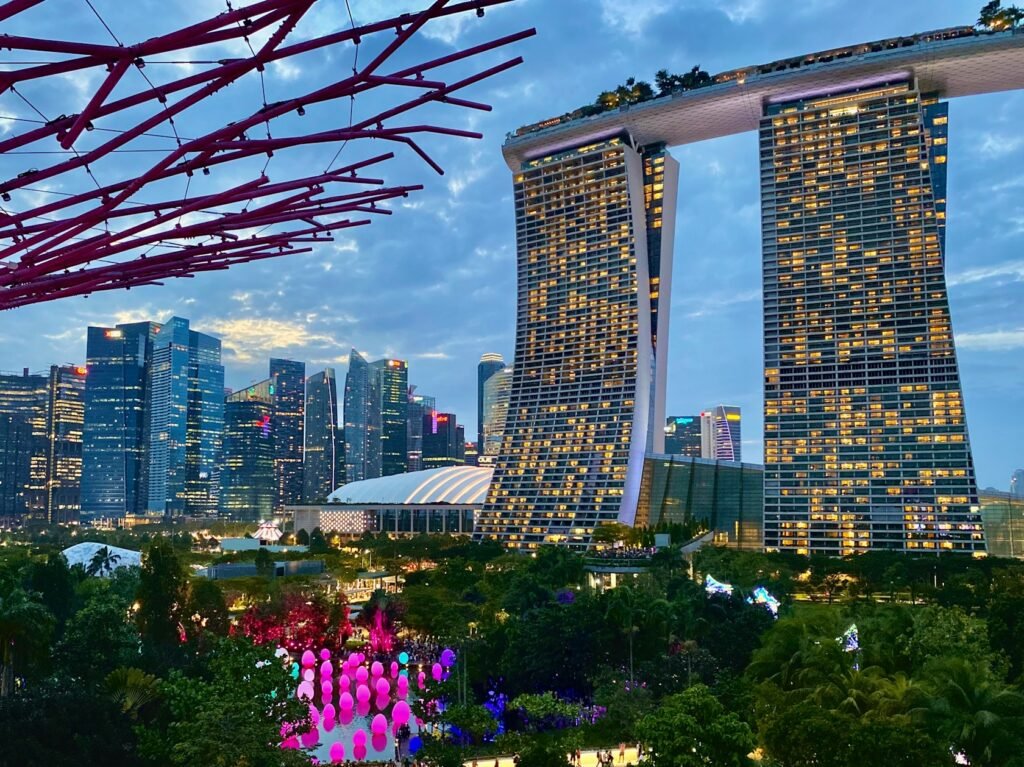
By this point, you’ve already experienced the polished, high-rise side of Singapore — glass towers, iconic architecture, reflections on the water. The Marina Bay Overpass marks a quiet but powerful transition between two contrasting worlds of the city.
This covered pedestrian bridge connects the ultra-modern Marina Bay Sands complex directly to Gardens by the Bay, allowing you to move seamlessly from a dense urban landscape into a futuristic tropical garden — without crossing roads or leaving the pedestrian zone.
Marina Bay Overpass (towards Gardens by the Bay)
If you are inside The Shoppes at Marina Bay Sands, follow the signs pointing to “Gardens by the Bay”. They lead you to the Marina Bay Overpass, which begins on the B2 level of the shopping complex.
The bridge is fully covered, making it comfortable in any weather. As you walk, the scenery gradually changes: the hard lines of architecture give way to greenery, open water, and the first silhouettes of the Supertrees appearing in the distance.
This is a subtle but memorable moment — one that visually explains Singapore’s idea of a “City in a Garden” better than words ever could.
🕘 Time on the overpass (with photos): ~15 minutes
📸 Best shots: Marina Bay Sands behind you, first views of Supertrees ahead
📍 Google Maps: Marina Bay Overpass
Why this transition matters
The Marina Bay Overpass is not just a shortcut — it is part of the experience.
In a matter of minutes, you move:
- from steel and glass
- to open water and greenery
- from a financial and entertainment hub
- to one of the most ambitious urban parks in the world
Few cities manage this contrast so smoothly, and this passage captures that transformation perfectly.
Time summary: Marina Bay Sands → Gardens by the Bay
- Minimum: ~15 minutes
- Comfortable pace: ~25 minutes (with photos)
If you want to start the route from this location
🚕 Taxi drop-off: Bayfront Station Exit B (near Marina Bay Sands)
🚇 Nearest MRT station: Bayfront MRT
(Downtown Line – Blue, Circle Line – Yellow)
From the station, head toward Marina Bay Sands and follow the pedestrian signs to the overpass.
Location 5: Gardens by the Bay — Stepping into Another World 🌌🌿
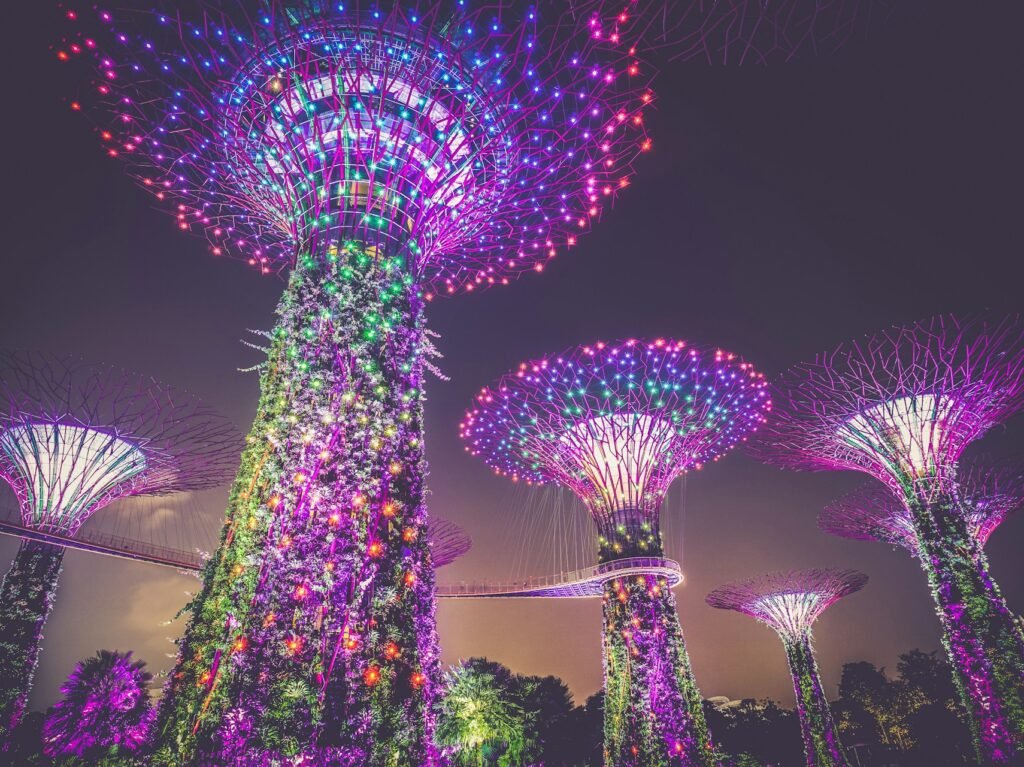
Gardens by the Bay is not just a park — it is one of Singapore’s strongest visual statements. This is where the city’s ambition to become a “City in a Garden” turns into a lived experience.
After the bright lights and glass facades of Marina Bay, the gardens feel like crossing into another dimension: cooler air, lush greenery, soft lighting, and futuristic structures rising above tropical plants. This contrast is exactly why it’s best to arrive here after sunset.
Take your time here — this is where the route slows down and becomes immersive.
Dragonfly Lake Bridge — A Quiet Transition into the Gardens 🌿
As soon as you descend from the Marina Bay Overpass, continue straight along the path toward Dragonfly Lake Bridge. This small bridge leads you deeper into the park and gently guides you toward the Supertree Grove.
The lake itself is part of the gardens’ eco-engineering system. Dragonfly Lake functions as a natural biofilter: aquatic plants help purify the water, which is then reused to irrigate the gardens. The presence of dragonflies here is a sign of a healthy ecosystem — a subtle but intentional detail in the park’s design.
🚶♂️ Walk to the bridge: ~2 minutes
🕘 Crossing + photos: ~5 minutes
📍 Google Maps: Dragonfly Lake Bridge
Supertree Grove — The Heart of Gardens by the Bay 🌳✨
The Supertrees are the most iconic elements of the park — vertical gardens rising up to 50 meters high. These structures are not purely decorative: they support living plants, collect rainwater, and generate solar energy used to power the park.
During the day, they impress by scale.
At night, they become something else entirely.
Garden Rhapsody — Free Light & Music Show 🎶✨
If you arrive at the right time, you’ll witness Garden Rhapsody, a free light-and-sound show where the Supertrees come alive in sync with music.
🕘 Showtimes:
- 7:45 PM
- 8:45 PM
The show lasts about 15 minutes and is one of the most atmospheric experiences in Singapore — no tickets, no queues, just lie back or stand beneath the trees and look up.
🕘 Time in the grove: ~10–15 minutes
📍 Google Maps: Supertree Grove
OCBC Skyway — Walking Among the Supertrees (Optional) 🌉
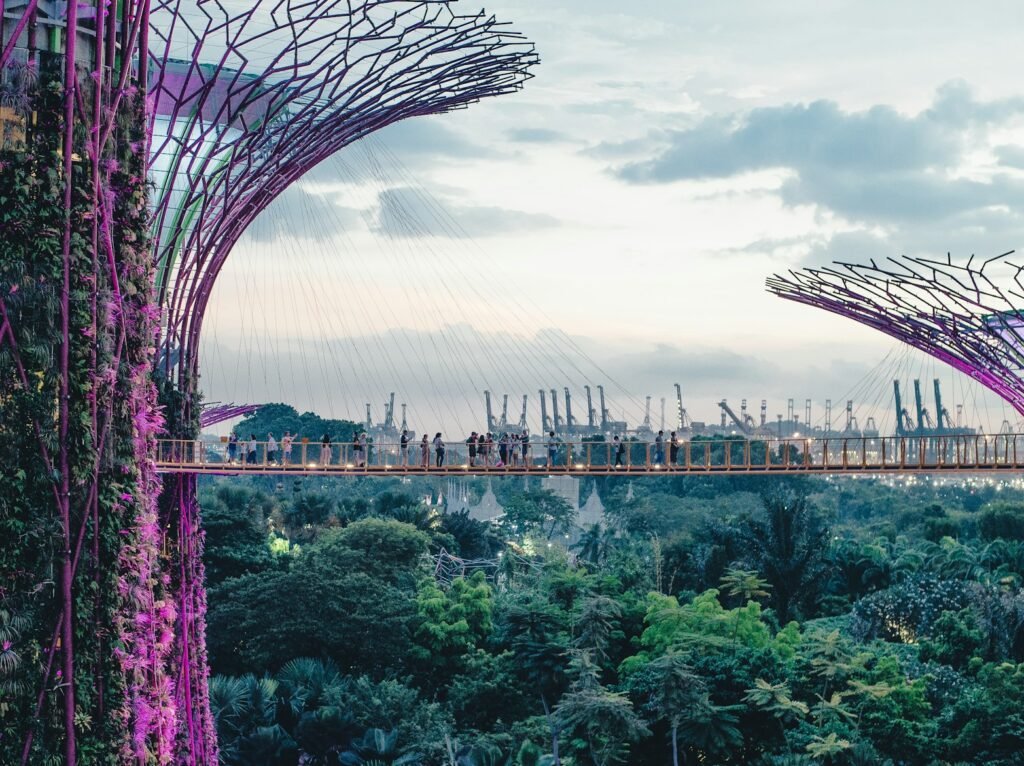
For a different perspective, you can walk across the OCBC Skyway, a suspended walkway connecting several Supertrees at a height of about 22 meters.
From here, you get panoramic views of:
- Gardens by the Bay
- Marina Bay Sands
- the illuminated skyline
It’s a short walk, but visually very rewarding.
💰 Paid entry: from SGD 10
🕘 Time needed: ~15 minutes
📍 Google Maps: Supertree Grove
Chinese Garden — Symbols, Balance, and Calm 🎋
Inspired by classical southern Chinese gardens, this area focuses on harmony, symbolism, and balance.
Here, every element has meaning:
- Water represents life and flow
- Rocks symbolize mountains and stability
- Plants carry cultural symbolism rather than just decorative value
You’ll see bamboo (resilience and flexibility), pine trees (longevity), and peonies (wealth and prosperity). The quiet design creates a strong contrast with the futuristic Supertrees nearby.
🕘 Time needed: ~10 minutes
📍 Google Maps: Chinese Garden
Indian Garden — Sacred Plants and Cycles of Life 🌺
The Indian Garden draws inspiration from traditional South Indian temple gardens, where plants are part of spiritual practice.
This space reflects ideas of renewal, balance, and connection to nature. Look for:
- Ashoka trees, symbolizing joy and rebirth
- Tulsi (holy basil), sacred in Hindu traditions
The garden highlights Singapore’s multicultural identity and the influence of Indian heritage on the city’s cultural landscape.
🕘 Time needed: ~10 minutes
📍 Google Maps: Indian Garden
Cloud Forest — A Walk Through the Mist 🌫️
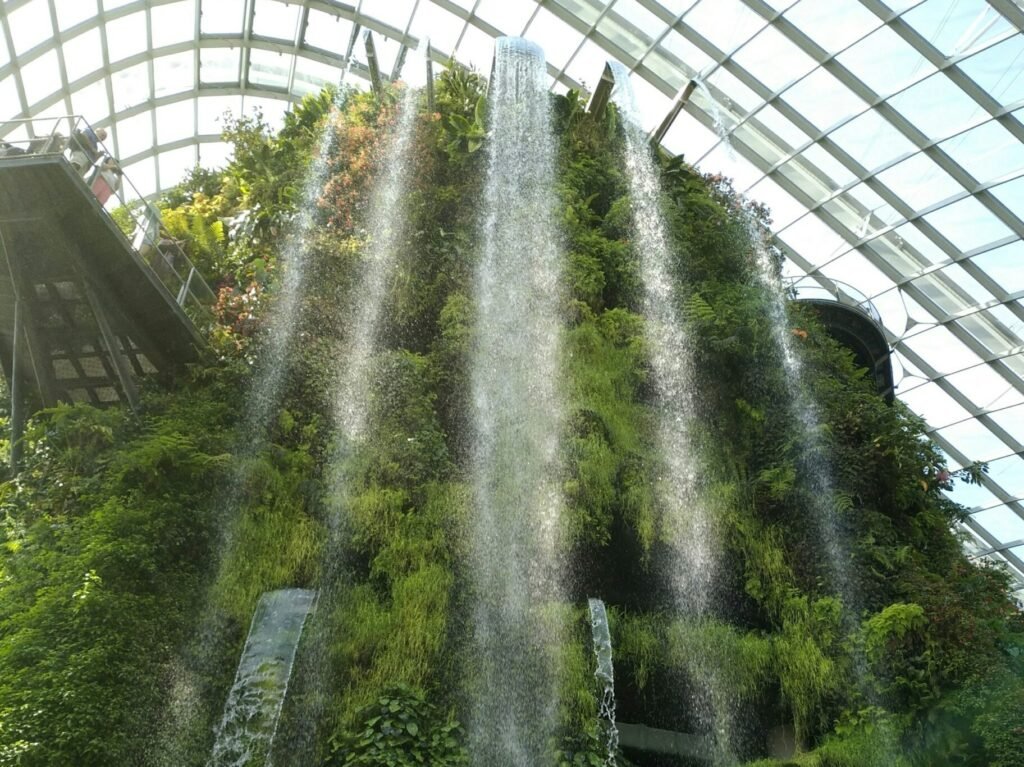
Opened in 2012, Cloud Forest is one of the most unique indoor gardens in the world. It recreates mountain cloud forests found in regions such as the Andes and Southeast Asia.
The experience begins at the top, near a 35-meter indoor waterfall, and continues downward along elevated walkways through mist and lush vegetation.
Beyond the visual impact, the exhibition focuses on:
- fragile ecosystems
- climate change
- biodiversity
🚶♂️ Walk to Cloud Forest: ~3 minutes
🕘 Time inside:
- ~40 minutes (quick visit)
- up to 1.5 hours (slow exploration)
📍 Google Maps: Cloud Forest
Flower Dome — Plants from Around the World 🌸
The Flower Dome is the world’s largest column-free greenhouse and a Guinness World Record holder.
Unlike Cloud Forest, it showcases plants from dry and Mediterranean climates, including:
- olive trees from Europe
- succulents and cacti from Africa
- eucalyptus from Australia
- seasonal floral displays
Thanks to rotating exhibitions, the dome feels different even on repeat visits.
🚶♂️ Walk to Flower Dome: ~1 minute
🕘 Time inside:
- ~40 minutes (quick visit)
- up to 1.5 hours (slow exploration)
📍 Google Maps: Flower Dome
Time Summary: Gardens by the Bay
- Minimum: ~1 hour
(Outdoor areas only, no domes or Skyway) - Unhurried visit: ~4 hours
(Supertrees, Skyway, Cloud Forest, Flower Dome)
If you want to start the route from this location
🚕 Taxi drop-off: parking area near Cloud Forest
🚇 Nearest MRT station: Gardens by the Bay MRT
(Teal Thomson–East Coast Line)
From the station, head toward Marina Bay Sands and follow the pedestrian signs to the overpass.
Final Stage: Returning to Changi Airport — A Calm Ending to the Journey ✈️
After a full day of walking, architecture, gardens, and city views, it’s time to head back to the airport. The key rule here is simple: leave yourself a comfortable buffer.
Singapore’s transport system is reliable, but this is not the moment to rush. Plan to arrive at Changi Airport at least 2–2.5 hours before your flight — especially if you’re traveling internationally.
Option 1: Taxi (Grab) — Fastest and Easiest 🚕
If you’re short on time or simply want a smooth, stress-free return, taxi is the best option.
From Gardens by the Bay, open the Grab app and set your destination to Singapore Changi Airport (SIN). Taxi pickup points are clearly marked near the park exits.
⏱ Travel time: ~20–25 minutes
💰 Cost: higher than MRT, but predictable
👍 Best for: short layovers, late evenings, tired travelers
taxi
🚕 Taxi pickup point (Google Maps): parking area near Cloud Forest
This option is especially convenient after dark, when you’ve already covered a lot of ground on foot.
Option 2: MRT — Reliable and Budget-Friendly 🚆
If you still have enough energy and time, the MRT is a solid alternative.
- Walk back toward Bayfront MRT Station
(Downtown Line – Blue) - Transfer to the East–West Line (Green) toward Changi Airport
⏱ Total travel time: ~1–1.5 hours
💰 Cost: lower than taxi
👍 Best for: daytime returns, generous layovers
🚇 MRT station: Gardens by the Bay MRT (Teal Thomson–East Coast Line)
Location 6: Jewel Changi — If You Have Extra Time ⏳
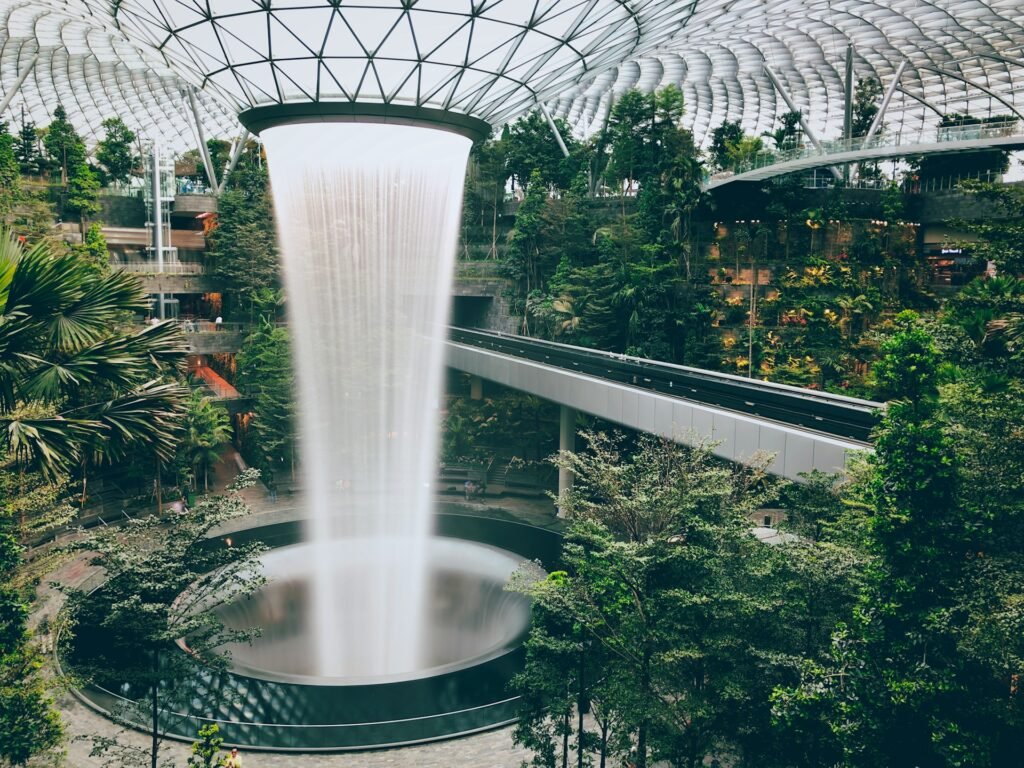
Sometimes, after completing the main route, you suddenly realize you still have an extra hour or two. Too much to just sit at the gate — but not enough to start something new.
In Singapore, this time can easily become the final highlight of your journey.
The best option is to return to the airport a bit earlier and spend that time at Jewel Changi Airport.
Jewel Changi Airport — More Than Just an Airport Mall
Jewel Changi is not a typical shopping center. It’s a public space where even locals come to walk, relax, and meet friends.
The main attraction here is Rain Vortex — the world’s tallest indoor waterfall, cascading through the center of a glass dome surrounded by a lush indoor forest.
The best way to experience it is from the lower level, walking slowly around the greenery, watching the water fall from above, and letting the pace of travel finally slow down.
What You Can Do at Jewel
Around the waterfall you’ll find:
- indoor gardens with tropical plants
- panoramic walkways and viewing platforms
- cafés and restaurants with waterfall views
- quiet corners to sit, rest, and recharge
It’s an ideal place to have a coffee, review photos from the day, and gently transition back into travel mode before your next flight.
If comfort is your priority, Jewel is also close to:
- airport lounges
- rest zones with reclining seats
- spa and relaxation facilities
A rare combination for an airport — and a perfect way to end a Singapore layover.
How Much Time to Plan
- Minimum: 30–45 minutes — quick walk and photos
- Comfortable: 1–2 hours — slow stroll, coffee, relaxation
If you have more time than expected, Jewel never feels like wasted time.
Time Summary ⏱️
Singapore Layover Route — Time Breakdown
| Time | Location | Duration | Notes |
|---|---|---|---|
| Travel from the airport ✈️ | ~25 min | Taxi drive without traffic (recommended) | |
| 15:00–16:10 | Changi Airport → Chinatown | ~1 hour (MRT) or ~25 min (taxi) | MRT or Grab taxi |
| Chinatown 🏮 | ~1.5-2.5 hours | Temples, street life, food | |
| 16:10–16:30 | Buddha Tooth Relic Temple | ~20 min | Interior visit |
| 16:30–17:10 | Chinatown Complex Hawker Centre | ~40 min | Lunch |
| 17:15–17:45** | Chinatown Heritage Centre (optional) | ~30–60 min* | Optional museum visit |
| 17:50–18:05 | Pagoda Street | ~15 min | Shops & shophouses |
| 18:05–18:20 | Sri Mariamman Temple | ~15 min | Hindu temple |
| Walk to Marina Bay 🌊 | ~40 min | Scenic riverside walk | |
| 18:20–18:40 | Jubilee Bridge | ~10 min | Photos |
| 18:40–18:50 | Waterfront Promenade | ~10 min | City views |
| Marina Bay 🌃 | ~1 hour | Architecture & skyline | |
| 19:00–19:10 (sunset) | Helix Bridge | ~10 min | Sunset views |
| 19:10–19:40 | ArtScience Museum (outside) | — | Photo stop |
| 20:00–20:15 | The Shoppes at Marina Bay Sands | ~30 min | Indoor walk: canal with boats, waterfall |
| Spectra Light & Water Show ✨ | ~15 min | Free evening show | |
| Gardens by the Bay 🌿 | ~1–4 hours | Futuristic tropical gardens | |
| 20:30–20:45 | Marina Bay Overpass | ~15 min | Scenic bridge walk through Marina Bay Sands hotel |
| 20:50–20:55 | Dragonfly Lake Bridge | ~5 min | Walk across the lake |
| 21:00–21:15 | Supertree Grove | ~15 min | Evening walk among the Supertrees |
| 21:20–21:35** | OCBC Skyway (optional) | ~15 min* | Elevated walkway among the Supertrees (Paid) |
| 21:40–21:50 | Chinese Garden | ~10 min | A short walk through the garden |
| 21:55–22:05 | Indian Garden | ~10 min | A short walk through the garden |
| 22:10–22:50** | Cloud Forest (optional) | ~40–90 min* | Optional interior visit |
| 23:00–23:40** | Flower Dome (optional) | ~40–90 min* | Optional interior visit |
| Return to airport ✈️ | ~25 min (taxi) | Taxi drive without traffic (recommended) | |
| 23:45–23:50 | Gardens by the Bay → Changi | ~1 hour (MRT) or ~25 min (taxi) | MRT or Grab taxi |
** Time is calculated for a minimal, fast-paced visit without stopping at every exhibit.
⏱ How Much Time Do You Need for This Singapore Layover Guide?
When planning a city visit during a layover, keep in mind that your total layover time must be longer than the itinerary itself.
Add ~3 hours on top of your planned city time to safely account for airport procedures and return at least 2–2.5 hours before departure for security and boarding.
✈️ Airport Transfer Time (Round Trip)
Add travel time between the airport and the city:
- 🚕 Taxi / Grab: ~50 minutes total (to and from the airport)
- 🚇 MRT: ~2–3 hours total (to and from the airport)
💎 Optional Time Add-Ons
Add the optional attractions only if time allows:
- 🏛️ +30–60 min — Chinatown Heritage Centre
- 🌿 +40–90 min — Cloud Forest
- 🌸 +40–90 min — Flower Dome
✅ Total Time Scenarios
Putting It All Together: How Much Time You Need to Follow This Itinerary.
🌿🧘♀️ At a relaxed pace: ~9+ hours (~12+ hours layover)
- 🚶♀️ ~8–9 hours relaxed city walk.
More time for indoor attractions, photography, and enjoying the OCBC Skyway without rushing. - 🚕 Taxi / Grab: ~50 minutes (to and from the airport)
🌤️🚶♀️ Comfortable: ~7-8 hours (~10-11 hours layover)
- 🚶♀️ ~6-7 hours balanced city walk.
Includes a quick visit to optional indoor attractions and the OCBC Skyway. - 🚕 Taxi / Grab: ~50 minutes (to and from the airport)
👟⚡ Minimum: ~4.5 hours (~7.5+ hours layover)
- 🚶♀️ ~3.5 hours active city walk.
Skip optional indoor attractions and the OCBC Skyway. Best if you are short on time. - 🚕 Taxi / Grab: ~50 minutes (to and from the airport)
✈️⏱️ Limited Time Option (5–7 hours layover)
- 🚶♀️ ~1-3 hours city walk.
Focus on one main area only.
Head straight to Marina Bay or Gardens by the Bay instead of following the full route. - 🚕 Taxi / Grab: ~50 minutes (to and from the airport)
Why This Itinerary Works for a Layover
Singapore’s compact layout, excellent transport, and safety make it one of the best cities in the world for a long layover.
With this route, even a single free day feels like a complete travel experience — not just a stop between flights.
FAQ: Frequently Asked Questions
1. How many hours of layover do you need to see Singapore?
Minimum — from 5.5 hours. Optimal — 8–12 hours.
If your layover is less than 5 hours, it’s better to stay at the airport and explore Jewel Changi — a futuristic complex inside the airport where tropical gardens and the world’s tallest indoor waterfall sit under a giant glass dome, combined with excellent shopping and relaxation areas.
With a 5.5+ hour layover, a great option is the free Singapore city tour from Changi Airport, which allows you to see the city without planning everything yourself.
If you have 8 hours or more, you can comfortably enjoy a full itinerary and follow the route described in this guide.
2. Do you need a visa to leave the airport during a layover in Singapore?
For most travelers, no visa is required for transit in Singapore — the country offers visa-free transit for up to 96 hours, provided you are continuing to a third country.
To use visa-free transit, you need:
- a confirmed onward ticket to a third country, and
- enough time to return to the airport at least 2 hours before departure.
Passport control at Changi Airport is usually fast and well-organized.
3. How do you get from Changi Airport to the city center?
MRT (metro) is a convenient option. The ride to the city center takes about 1 hour, trains run frequently, and navigation is easy even for first-time visitors.
A faster option is taxi or Grab — the ride usually takes 20–25 minutes, depending on traffic.
Both options are safe and suitable even for relatively short layovers.
4. Can you stay overnight at Singapore Changi Airport?
Yes — and it’s one of the most comfortable airports in the world for an overnight stay.
Changi Airport offers:
- transit hotels (bookable for a few hours),
- lounges with showers,
- free rest areas with loungers,
- 24/7 cafés and food courts.
Even if you stay entirely within the transit zone, spending the night here is clean, calm, and safe.
5. What should you definitely see in Singapore during a short layover?
If time is limited, focus on one area — Marina Bay:
- the waterfront with views of the Marina Bay Sands “ship” hotel,
- ArtScience Museum,
- Helix Bridge,
- Spectra – Light & Water Show (free in the evening).
This area gives you the most iconic views in the shortest amount of time.
6. Is the free Singapore city tour from the airport real?
Yes. Free Singapore Tour is an official program organized by Changi Airport.
The tour lasts about 2–3 hours, is conducted in English, and includes transportation and a guide.
Registration takes place directly at the airport, at dedicated counters in the transit area.
It’s a great option if you don’t want to plan a route yourself.
7. Is it safe to walk around Singapore in the evening or at night?
Yes. Singapore is considered one of the safest cities in the world. Even in the evening and at night, the city feels calm, clean, and well-lit.
Keep in mind:
- public transport runs until around midnight,
- taxis and Grab operate 24/7.
8. What can you see at Changi Airport if you don’t leave the airport?
Even without leaving the airport, you can have a great experience:
- Jewel Changi — visit the iconic Rain Vortex, the world’s tallest indoor waterfall, surrounded by lush greenery;
- Themed gardens — including the Butterfly Garden, Cactus Garden, and Orchid displays inside the terminals;
- Shopping and dining — hundreds of stores and restaurants, from street food to fine dining;
- Rest and entertainment zones — free movie theaters, premium lounges, spas, and even swimming pools.
For a short layover, Changi Airport alone is one of the best in the world.
9. Is it worth going into the city during a night layover in Singapore?
If you’re looking for rest and quiet — the airport is perfect for that.
If you want impressions and atmosphere — go into the city.
An evening walk around Marina Bay leaves a strong impression and truly feels like you’ve visited Singapore, even during a short stop.
You May Also Like
- One Day in Bangkok: Best 1-Day Itinerary for First-Time Visitors
- Wintering in Phuket: An Honest Review and Real Life by the Sea
- A Week in Nha Trang travel guide: Sea, Food, and Adventures in Vietnam
Useful Links
Official Singapore Tourism Portal
https://www.visitsingapore.com
(Up-to-date information on city neighborhoods, attractions, and events from the Singapore Tourism Board.)
Official Singapore Changi Airport Website
https://www.changiairport.com
(Information on terminals, transit procedures, free city tours, and airport services.)
Singapore MRT Map
https://www.lta.gov.sg/content/ltagov/en/getting_around/public_transport/rail_network.html
(Official map of Singapore’s metro lines.)
Book a Taxi (Grab App)
https://www.grab.com/sg/download
(Ride-hailing app widely used in Singapore.)