This article contains affiliate links. If you book through them, we may earn a small commission — at no extra cost to you. This helps support the project.
For wine lovers, Kakheti offers something few other regions can: the chance to come remarkably close to the beginnings of wine. It was in Georgia that the world’s oldest wine was discovered.
What makes this history even more remarkable is that this ancient way of making wine is still used in Georgia today. Here, 8,000 years of wine history are not only preserved — they can be tasted.
Kakheti: The Heart of Georgian Wine
Kakheti lies in eastern Georgia, just a few hours’ drive from Tbilisi, the capital of Georgia.
Wine here is deeply tied to home, land and family memory. Even if it is your first time in the country, Kakheti quickly explains one of the most important things about Georgia: wine is not just a drink. It is a language of hospitality.
But to understand why Georgian wine matters far beyond Georgia itself, we need to go back almost eight thousand years.
Was the World’s Oldest Wine Really Found in Georgia?
Yes — and it is one of the most striking facts about Georgian wine. But what exactly did archaeologists find?
In pottery fragments discovered at Neolithic sites south of Tbilisi, researchers identified chemical traces associated with grape wine. The vessels date to around 6000 BC, making them the earliest known evidence of grape winemaking.
What makes this discovery especially striking is that the story of wine and clay did not end in the Neolithic period. Thousands of years later, clay vessels still lie at the heart of Georgian winemaking. In Kakheti, they are now known as qvevri.
Qvevri: Georgia’s Ancient Clay Vessels That Still Shape Its Wine
A qvevri is a large clay vessel traditionally used to ferment, store and age wine. It is usually buried underground, where the surrounding earth helps maintain a stable temperature.
In 2013, UNESCO recognized the traditional Georgian method of qvevri winemaking as part of the world’s intangible cultural heritage.
Now, 8,000 years after this winemaking tradition began, clay vessels are still used in family cellars and modern wineries across Kakheti. When you step into a traditional Georgian wine cellar, known as a marani, and see the round openings of qvevri set into the floor, it is hard not to wonder: could this be how winemaking began?
How Qvevri Winemaking Shapes the Taste
The long months inside a qvevri allow the wine to develop texture, depth and structure. When the juice remains in contact with the grape skins, seeds or stems, the effect can be even more pronounced, producing wines that feel fuller, firmer and more complex on the palate.
The influence of qvevri winemaking is especially striking in amber wine.
Amber Wine: When White Grapes Behave Like Red
If you choose just one wine to remember from Kakheti, make it amber wine.
Its name comes from the deep golden or amber color that develops during prolonged contact with the grape skins. But although amber wine is made from white grapes, it can have more in common with red wine than you might expect: it is often dry, intense and slightly tannic, with a full texture and notes of tea, nuts, spices or honey.
Georgian Grapes to Try in Kakheti
Kakheti is home to dozens of native grape varieties, but you do not need to remember them all before your first tasting. Four names will give you a good place to start: Saperavi, Rkatsiteli, Mtsvane Kakhuri and Kisi.
Saperavi is Georgia’s leading red grape and one of the first wines to try if you enjoy bold reds. Even its flesh is red, giving the wine its remarkably deep color. Expect dark fruit, spice, firm structure and, in some versions, earthy or smoky notes.
Rkatsiteli is Kakheti’s most important white grape. Made in the European style, it can be crisp and refreshing, with notes of green apple, quince or peach. Made with prolonged skin contact in qvevri, the same grape can produce a fuller, more tannic amber wine.
Mtsvane Kakhuri is often more aromatic, with floral, fruity and sometimes mineral notes. You may find it on its own, but it is also frequently blended with Rkatsiteli, bringing additional fragrance and freshness to the wine.
Kisi is another white grape worth looking for, particularly if you want to explore amber wine beyond Rkatsiteli. Qvevri versions can be rich and expressive, with notes of ripe pear, dried fruit, herbs, nuts or spices.
You will encounter many more names as you travel through Kakheti, but these four are enough to make your first tastings feel far less unfamiliar.
The Alazani Valley: The Landscape That Makes Kakheti Unforgettable
Kakheti does not win people over with wine alone. Many travelers come here for tastings, but quickly realize that the landscapes of the Alazani Valley are just as strong a reason to stay longer.
It is no surprise that this part of Georgia is considered one of the country’s most popular travel destinations.
Sun, Mountains and Vineyards: Why the Alazani Valley Matters So Much for Kakhetian Wine
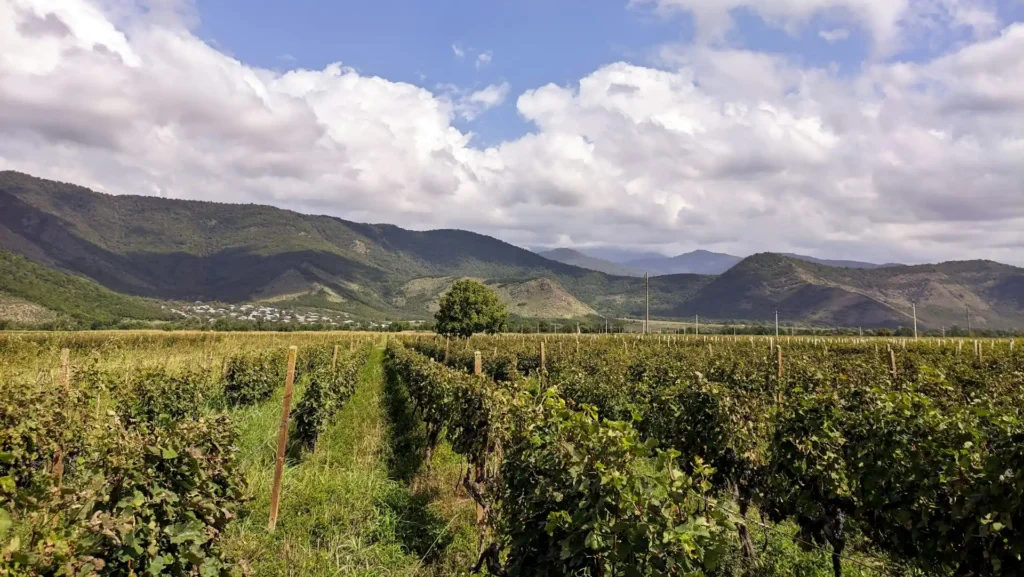
The Alazani Valley stretches between the wooded slopes of the Gombori Range and the high Caucasus Mountains. Its long, warm summers and abundant sunshine create excellent conditions for growing grapes, but the valley is far from uniform. Vineyards differ in elevation, exposure to the sun and soil composition. These variations affect how quickly the grapes ripen, how much acidity they retain and, ultimately, the character of the wine produced in different parts of Kakheti.
You feel that landscape throughout the journey. Roads run between vineyards, gardens and villages, while the Caucasus Mountains form a dramatic backdrop in the distance. On clear days, their peaks remain in view as you travel through the valley, so even the drive between wineries feels like an essential part of the trip.
Rtveli: Why the Grape Harvest May Be the Best Time to Visit
If you want to see the Alazani Valley not only at its most beautiful but also at its most alive, visit during Rtveli, the grape harvest. Wineries are at their busiest: grapes arrive from the vineyards, families and workers gather around the harvest, and visitors may see the first stages of winemaking rather than only taste the finished wine. In the Alazani Valley, Rtveli usually takes place in early autumn, although the exact dates depend on the weather, grape variety and winery.
If Rtveli is the main reason for your trip, check the dates with wineries or local guides in advance. If the timing works out, you will see Kakheti’s wine culture in motion — and it may become one of the most memorable experiences of the journey.
Where to Stay: Telavi or Sighnaghi
Where you stay in Kakheti will shape the experience of your trip. If you have only one day, you will probably need to choose between Sighnaghi and Telavi. With two or three days, you can easily combine both towns.
Sighnaghi: Kakheti’s Most Photogenic Town Above the Alazani Valley
📌 Google Maps: Sighnaghi
Sighnaghi is often the first town travelers see in Kakheti. And it is easy to understand why: it is beautiful, compact and very photogenic.
It is often called the City of Love, and for many travelers, that name takes on another meaning: Sighnaghi is where they first fall in love with Kakheti itself.
The main reason to come here is the view of the Alazani Valley. Sighnaghi stands on the hills, offering sweeping views across the vineyards toward the Caucasus Mountains on clear days. The town feels like a change of rhythm: less noise, more air, more light and more space.
Sighnaghi is a good place for a slow walk, lunch with a beautiful view of the Alazani Valley and your first tasting of Kakhetian wine. But it is important to remember: this is not the whole of Kakheti. It is more like its beautiful front door.
Telavi: A Town Surrounded by Wineries and Monasteries
📌 Google Maps: Telavi
Telavi is one of the best options for those who want to stay in Kakheti for a few days. It is conveniently located for trips around the region to wineries and monasteries.
If Sighnaghi looks more like a postcard, Telavi works as a practical base for a longer journey. At first glance, it may feel less romantic. But from here, it is easier to explore the scenic route beneath the Caucasus Mountains and add monasteries and the Tsinandali Estate to your route.
Historic Places to Visit in Kakheti
Kakheti is not only about wine, and that is exactly what makes the trip more interesting.
Between tastings, you can visit monasteries, old estates, small towns, fortresses and viewpoints. These stops reveal the history and landscapes behind Kakheti’s wine culture.
Tsinandali Estate: Where Georgian Wine Met Europe
People usually come to Tsinandali for the historic estate of Alexander Chavchavadze — one of the best-known places in Kakheti. Here you can walk through the old park, visit the house museum, see the historic wine cellar and try local wine.
Another reason to visit Tsinandali is that one of the most famous five-star hotels in Kakheti is located on the grounds of the historic complex: Tsinandali Estate, A Radisson Collection Hotel.
The hotel is considered one of the most prestigious in the region: it belongs to the premium Radisson Collection brand and offers what travelers usually expect from a luxury stay — a spa area, a pool with a view, restaurants, bars, its own wine cellar, a unique location and a design that fits the atmosphere of the historic estate.
Tsinandali shows a different side of Georgian wine history — aristocratic, outward-looking and strongly influenced by Europe.
Ancient Monasteries of Kakheti: Nekresi, Alaverdi and Gremi
If you want to add history to your wine route, choose one or two monasteries.
Alaverdi — Wine, Faith and Centuries of History
Alaverdi is not just a monastery with ancient walls and a tall church: the monastery preserves a winemaking tradition, and the place itself helps you understand why wine in Georgia is connected not only with feasts and family marani, but also with monastic culture.
It is also a good stop for lunch or dinner: there is a restaurant by the monastery where you can try local food and wine.
📌 Google Maps: Alaverdi
🛏️ Where to stay: Telavi
Gremi — A Fortress Above the Alazani Valley
Gremi is worth visiting for its stone fortress, the Church of the Archangels and panoramic views over the Alazani Valley. Once the capital of the Kingdom of Kakheti, Gremi now makes a convenient historic stop between winery visits.
This place will be especially interesting for those who love history: Gremi Fortress now operates as a museum.
📌 Google Maps: Gremi
🛏️ Where to stay: Telavi
Nekresi — Ancient Walls and Sweeping Valley Views
Nekresi is an ancient monastery complex on a slope above the Alazani Valley. Come here for old stone walls, panoramic views and the feeling of height: from above, Kakheti unfolds below as a patchwork of vineyards, villages and distant mountains.
Compared with Gremi, Nekresi feels quieter and more secluded, with the landscape taking center stage.
📌 Google Maps: Nekresi
🛏️ Where to stay: Telavi, Sighnaghi
Planning a Trip to Kakheti
How to Get from Tbilisi to Kakheti
There is currently no airport in Kakheti with regular passenger flights, so most travelers get here from Tbilisi by car. If you want to rent a car, you can compare options on Localrent or GetRentacar.
Still, it is important to remember that Kakheti is a wine region — which means you should not get behind the wheel after tastings. The most convenient options for a wine route without having to drive a car are:
- A private driver is a good option for a day trip. Sometimes you can arrange a full-day trip with a regular taxi driver in Tbilisi.
- A pre-booked transfer is a good choice if you prefer to arrange everything in advance, although it may cost more.
- An organized tour is convenient for a first trip to Kakheti, but the pace can feel rushed, with limited time at each stop and tasting. You can check available tours to Kakheti on GetYourGuide and Viator, as itineraries, group sizes, prices, and cancellation terms may differ.
How Many Days Do You Need in Kakheti?
Kakheti is close to Tbilisi, so many people come here for one day. This option works well for a first introduction to the region. But if you truly love wine and beautiful mountains, it is worth staying longer.
To gain a deeper sense of the region and its history, a 2–3-day trip is ideal, though if you have the chance to give Kakheti a full week, you will not regret it.
Kakheti is best explored without a packed schedule. Tastings and lunches often last longer than planned, while the roads between vineyards invite you to slow down and stop for views and photos. A good wine day is not about checking places off a list. It is a day that stays with you — not only through the names of the wines, but also through the people you meet, the views, the smell of the cellar, the taste of fresh bread and the warmth of a Kakhetian evening.
Why Kakheti Changes the Way You See Georgia
In Kakheti, many sides of Georgia come together: ancient history, family traditions, monastery culture, vineyard landscapes, generous feasts and heartfelt hospitality that turns meals into long conversations around the table. The qvevri tradition is part of that living culture, passed down through generations and still practiced today.
That is why Kakheti is more than a beautiful place with good wine. You may come here for wine tastings but leave with a deeper understanding of the country itself.
FAQ: What to Know Before Visiting Kakheti
How Many Wineries Should You Visit in Kakheti?
Visiting one or two wineries per day is ideal; three is usually the maximum. This leaves enough time for lunch, historic stops and the journeys between wineries without turning the day into a rushed checklist. Kakheti is best explored slowly, with time to experience its culture and enjoy each stop.
What Is Qvevri?
A qvevri is a large clay vessel buried in the ground and used to ferment, age and store wine. The traditional Georgian method of qvevri winemaking is recognized by UNESCO as Intangible Cultural Heritage.
Can You Visit Kakheti as a Day Trip from Tbilisi?
Yes, you can visit Kakheti as a day trip from Tbilisi. One day is enough to see part of the region, visit one or two wineries and stop in Sighnaghi or Telavi. But if you want to explore without rushing, enjoy the views of the Alazani Valley and take your time over tastings, plan to stay for two or three days. For a deeper immersion in the region, consider spending a week.
Useful Links & Official Sources
Below are useful websites that may help you plan a trip to Kakheti.
Kakheti on Georgia’s official tourism website:
https://georgia.travel/regions/kakheti
The official section about Kakheti, with information about the region, wine culture, nature, towns and landmarks.
A convenient way to compare flights to Georgia:
https://www.aviasales.com
Aviasales helps you choose a suitable flight to Georgia by price, connections, baggage and departure time.