This article contains affiliate links. If you book through them, we may earn a small commission — at no extra cost to you. This helps support the project.
Mtskheta is one of Georgia’s oldest cities, with an archaeological landscape that preserves evidence of human activity and cultural development spanning roughly four millennia. From the 3rd century BC until the 5th century AD, it served as the capital of the ancient Kingdom of Kartli — an early Georgian state centered in what is now eastern Georgia and known to Greek and Roman writers as Iberia.
This full-day route is ideal for travelers interested in Georgian history, medieval architecture, mountain views and photography. It begins at Jvari, where Mtskheta can be seen from above, before continuing into the city and visiting the landmarks first seen from the hill.
Allow approximately 12 hours for the full itinerary, including dinner, from 9:00 a.m. to 9:00 p.m. The complete route is designed as a self-drive itinerary, while the sights in central Mtskheta can also be reached by public transportation or taxi and explored on foot. For more details on transportation and vehicle options, see the trip-planning FAQ below.
Tbilisi to Mtskheta Route Map
The interactive map contains two layers:
- The Route Stops layer shows the monasteries, churches, viewpoints, restaurants and exact parking points used in this itinerary.
- The Route Directions layer shows the recommended driving sequence between them.
The map separates ⭐ main stops from ➕ optional stops. If the day begins to run late, skip optional stops instead of shortening the visit to Svetitskhoveli or rushing through the Shio Mghvime complex.
➡️ First stop: Jvari Monastery (UNESCO)
1. Jvari Monastery: See Mtskheta Before Entering It
⭐ Main stop
🚗 Driving time from central Tbilisi: ~45–60 minutes
🛣️ Road conditions: paved and generally in good condition
⏱️ Time at the site: 40 minutes
🅿️ Parking: beside the monastery
📅 Closing time: currently listed as 5:30 p.m. daily
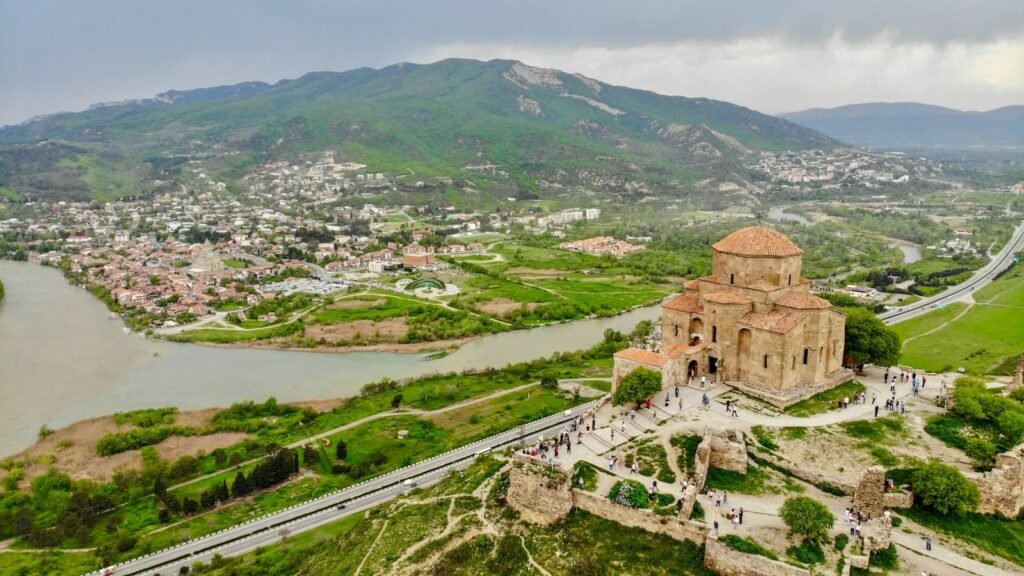
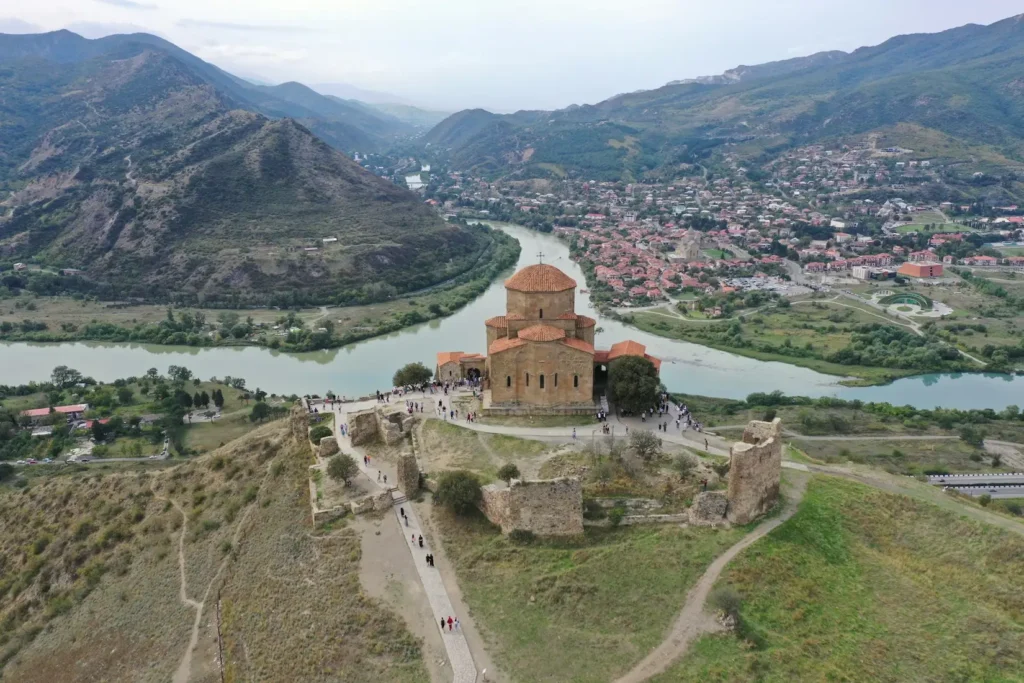
Jvari is the best first stop because it gives the rest of the route a geographical context. From the ridge, Mtskheta appears below at the confluence of the Aragvi and Kura rivers. Svetitskhoveli Cathedral rises from the center of the town, while the roads, surrounding hills and river valleys become easy to understand at a glance. Later, when walking through Mtskheta, it is much easier to recognize where each place sits within the landscape.
The viewpoint is one of Georgia’s classic panoramas, but Jvari is not merely a platform above Mtskheta. Its name means “cross” in Georgian. According to tradition, Saint Nino raised a wooden cross on this hill in the 4th century, soon after the conversion of the Kingdom of Kartli to Christianity. The place became sacred before the present monastery existed.
A smaller church was later built near the cross under the ruler Guaram. His son, Stepanoz I, commissioned the surviving main church between 585 and 604. The compact building became one of the defining works of early medieval Georgian architecture. Its tetraconch plan arranges four apses around a central domed space, creating a remarkably balanced structure that appears almost sculpted into the top of the hill. Early Georgian Asomtavruli inscriptions and donor reliefs survive on its walls.
Inside, the church is austere and relatively small. Its cross-shaped layout echoes both Jvari’s name (“cross”) and the sacred history of the hill. At its center stands the large cross associated with the earlier sacred site. Walk around the exterior as well: Jvari’s harmonious proportions reveal themselves from different angles.
The famous Mtskheta photographs are taken from the viewpoints on the Jvari side of the valley. Morning is particularly useful on this route: it reveals the city that will be explored next without sacrificing the afternoon to a separate return drive.
📝 40 minutes is sufficient for the church and panorama, although photographers may wish to stay longer.
⚠️ The ground around the monastery is uneven and can be windy even when Mtskheta below feels warm. Wear comfortable shoes and keep a light outer layer in the car.
➡️ Next stop: Pompey Bridge, on the way into Mtskheta.
2. Pompey Bridge: Mtskheta’s Hidden River Crossing
➕ Optional stop
🚗 Driving time from Jvari: ~15–20 minutes
🛣️ Road conditions: paved and generally in good condition
⏱️ Time at the site: 10 minutes
🅿️ Parking: the roadside viewing point is marked on the route map
In 65 BC, the Roman commander Pompey invaded the Kingdom of Iberia, or Kartli. King Artag retreated across the Mtkvari River (known internationally as the Kura River) and burned the wooden bridge behind him to slow the Roman army. After Pompey secured the territory on the opposite bank and prepared to cross the river, Artag opened negotiations, promising to rebuild the bridge and provide the Romans with supplies. He fulfilled both promises, although the fighting continued. A final treaty was reached only after another defeat, when Artag sent his children to Pompey as hostages. The crossing at Mtskheta is traditionally associated with this campaign, which is how it became known as Pompey Bridge.
The bridge seen today, when water levels allow it, is not a surviving Roman bridge. The crossing changed repeatedly over the centuries. It was reconstructed in the 5th century during the reign of Vakhtang Gorgasali and continued to evolve. Travelers in the late 18th and early 19th centuries described a structure that combined stone and timber and included defensive towers.
As heavier transport made the old bridge unsafe, it was replaced in 1839–1841 by a four-span stone arch bridge. That is the principal structure associated with the visible remains. Construction of the Zemo Avchala, or Zahesi, hydroelectric system in 1926 raised the water and submerged the bridge.
📝 Pompey Bridge is an easy historical stop as it lies directly on the driving route. Pull into the designated roadside space, look toward the river and continue to Samtavro. Allow 5–10 minutes at the viewpoint.
⚠️ The bridge may not be visible when the water level is high.
➡️ Next stop: Samtavro Monastery (UNESCO)
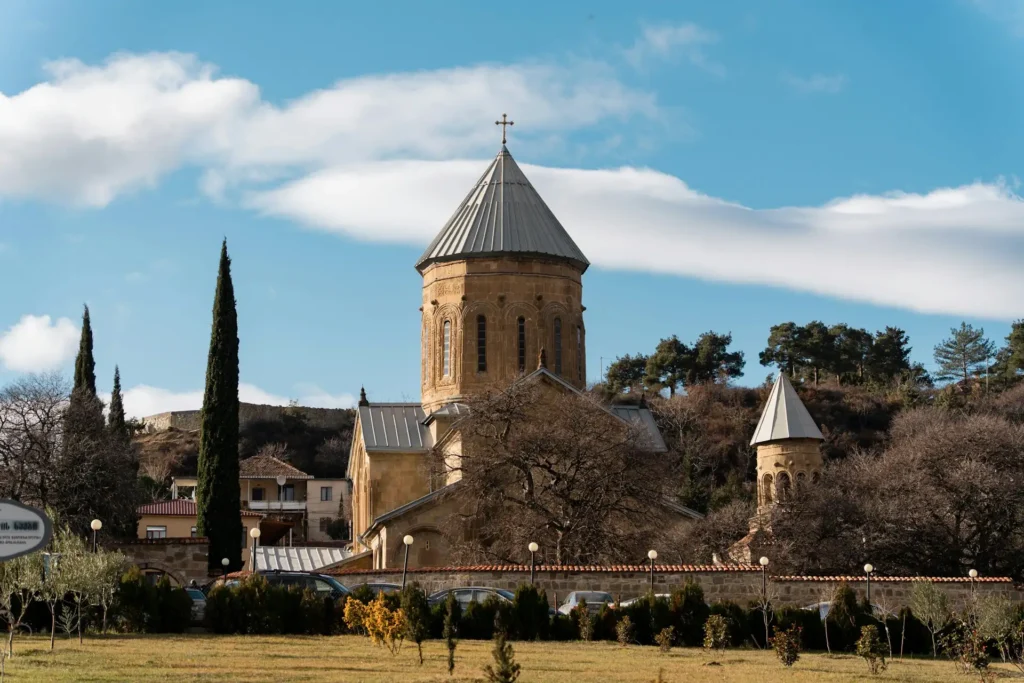
3. Samtavro Monastery: Royal History and the Story of Saint Nino
⭐ Main stop
🚗 Driving time from Pompey Bridge: ~5–10 minutes
🛣️ Road conditions: paved and generally in good condition
⏱️ Time at the site: 40 minutes
🅿️ Parking: directly beside the monastery
📅 Closing time: currently listed as 7:00 p.m. daily
Samtavro is one of the most important stops in the city center. The monastery stands in what was once a royal garden. Its name is commonly translated as “royal domain,” reflecting the site’s close connection with Georgia’s first Christian rulers. Saint Nino, revered as the woman who brought Christianity to Georgia, is one of the most important figures in the country’s religious history. According to Georgian Christian tradition, after arriving in Mtskheta, she settled in the royal garden where Samtavro Monastery now stands. She found shelter beneath a blackberry bush while preaching the new faith. A small church dedicated to her now marks the site associated with her stay.
The present complex brings together several historical periods. The main Church of the Transfiguration was built in the early 11th century, although worship on the site began much earlier. King Mirian III and Queen Nana, the royal couple connected with the official adoption of Christianity in Kartli, are buried inside. The smaller Church of Saint Nino preserves the memory of the saint’s first shelter, while the bell tower, walls and later monastic buildings show how the complex continued to develop.
Samtavro is also an active convent with carefully tended grounds. Its atmosphere differs from Jvari: rather than standing exposed on a rocky summit, it feels enclosed, green and intimate. The grave of the 20th-century Georgian saint Gabriel Urgebadze has made it an important pilgrimage place as well.
📝 Allow 40 minutes at the Samtavro Monastery complex to see both churches, the royal graves and the grounds without rushing. Remember that this is a working convent and pilgrimage site. Give worshippers space, speak quietly and avoid photographing people at prayer.
➡️ Next stop: lunch by the river
4. Lunch at Check-In Garden
🍴 Meal stop
🚗 Driving from Samtavro and finding parking: ~15 minutes
🛣️ Road conditions: paved and generally in good condition
⏱️ Time for lunch: 1 hour 15 minutes
🅿️ Parking: find a space near the restaurant and leave the car there for the Old Town walk
Check-In Garden is located on the Kura River waterfront in central Mtskheta and works well logistically: after lunch, the car can remain parked while the route continues on foot through the Old Town.
The restaurant has an atmospheric interior, but its small riverside garden terrace is the more memorable choice in pleasant weather. It is a comfortable place to slow the pace before the walking section of the day.
Two tortoises live in the garden and can sometimes be seen moving among the tables. Their appearance cannot be guaranteed, but they add a charming detail to lunch.
✅ The khachapuri is particularly good here, with flavorful, freshly baked bread.
📝 The timetable allows 75 minutes, enough for a proper meal without compressing the afternoon. If you are not hungry yet, explore Mtskheta Old Town (stop 5) and visit Svetitskhoveli Cathedral (stop 6) first, then return to the restaurant for lunch.
➡️ Next: walk around Mtskheta Old Town
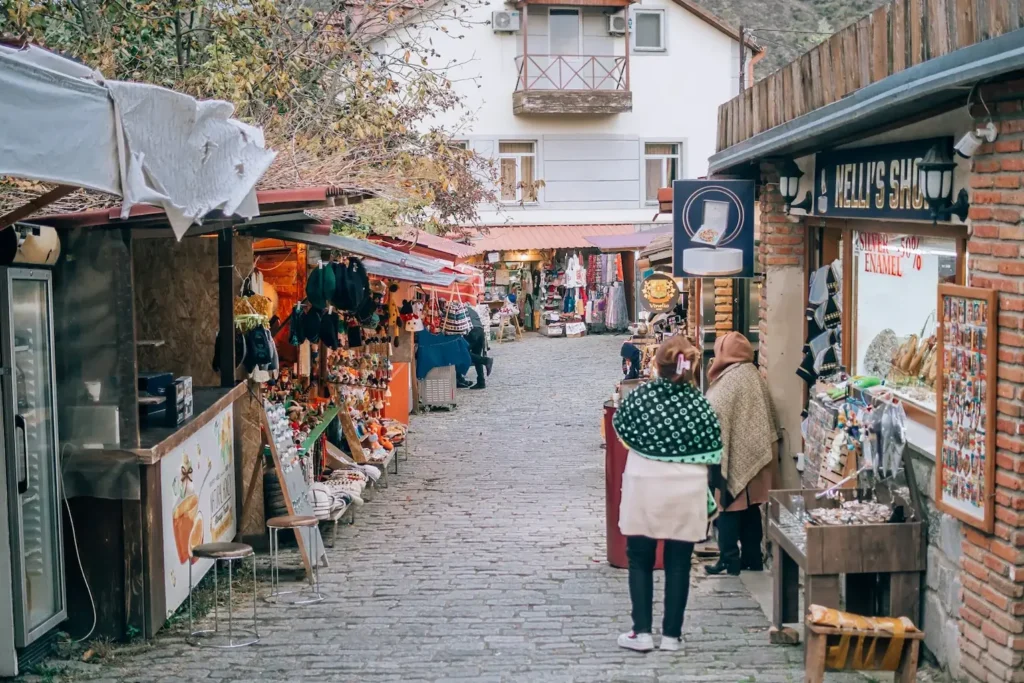
5. Mtskheta Old Town Walk: Souvenirs, Local Flavors and Historic Streets
⭐ Main stop
🚗 Driving: no driving (leave the car at the parking spot)
🚶 Walking time from the restaurant: ~2–5 minutes, depending on parking
⏱️ Time for the walk: 40 minutes
After lunch, continue through Mtskheta on foot. The compact Old Town is centered around Svetitskhoveli Cathedral, linking the riverfront, pedestrian lanes, market stalls and cathedral walls in an easy walk. After the quieter monastery visits, this part of the route brings a livelier atmosphere and time to browse local products and souvenirs.
Allow about 40 minutes to walk slowly along the stone-paved lanes and browse the small shops. The souvenir shops along Mtskheta’s main pedestrian street sell local crafts, churchkhela, dried fruit, spices and bottles of pomegranate wine. The latter is a fruit-based souvenir drink and differs from Georgia’s traditional grape wines made in qvevri.
📝 If lunch and the Old Town are reversed, do not move the car between them unless necessary. Parking once and walking is simpler than trying to stop immediately beside every point in the center.
⚠️ Cobblestones and uneven paving can be uncomfortable for wheelchairs, strollers and travelers with limited mobility.
➡️ Next: walk to Svetitskhoveli Cathedral (UNESCO)
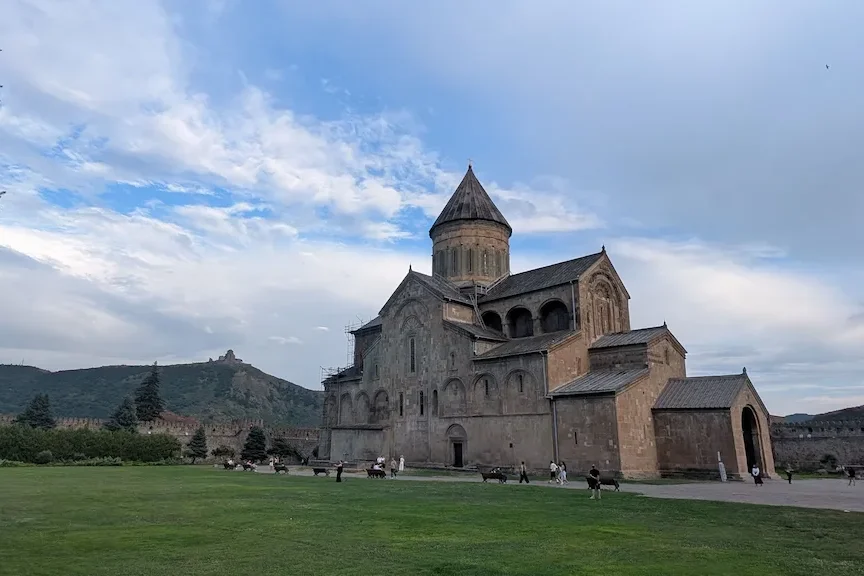
6. Svetitskhoveli Cathedral: The Spiritual Heart of Mtskheta
⭐ Main stop
🚗 Driving: no driving
🚶 Walking time from the souvenir shops: ~5–10 minutes
⏱️ Time at the site: 40 minutes
📅 Closing time: currently listed as 7:00 p.m., except Saturday at 4:45 p.m.
Svetitskhoveli is the historical and spiritual center of this route. Its name means “the Life-Giving Pillar,” a reference to the founding legend of the first church on the site.
One of Georgia’s most important Christian traditions holds that Christ’s Robe was brought from Jerusalem to Mtskheta and buried on the site where Svetitskhoveli Cathedral now stands. A cedar later grew above the burial place. When Saint Nino directed the construction of a church in the 4th century, seven pillars were cut from the cedar; according to legend, one rose miraculously into the air, descended only after her prayers and began to release healing myrrh. This “life-giving pillar” gave Svetitskhoveli its name.
King Mirian III commissioned the first wooden church here in the 4th century. The present cathedral was built in 1010–1029 under Catholicos Melchizedek I by the architect Arsukidze, whose name is preserved in an inscription.
Architecturally, the cathedral is a cross-domed building whose high central dome dominates Mtskheta’s skyline. Walk around the exterior before or after entering. The façades contain carved crosses, arches, animals, plants and geometric patterns created or altered during different phases of the cathedral’s long history. On the northern façade, a relief of an arm holding a builder’s square is traditionally associated with Arsukidze. Another popular legend claims that the architect’s hand was cut off after he surpassed his master. The story is folklore, not established history.
Inside, the scale is markedly different from Jvari and Samtavro. Look for surviving wall paintings, the stone canopy marking the place traditionally associated with Christ’s Robe and the tombs of Georgian rulers. Svetitskhoveli served as a setting for coronations and royal burials.
Svetitskhoveli, Jvari and Samtavro were inscribed together on the UNESCO World Heritage List in 1994. UNESCO recognizes them as exceptional examples of medieval church architecture in the Caucasus and as evidence of Mtskheta’s role in the introduction and spread of Christianity in the region.
📝 40 minutes is a practical minimum for the cathedral, courtyard and exterior.
➡️ Next stop (optional): Kaloubani St George Church
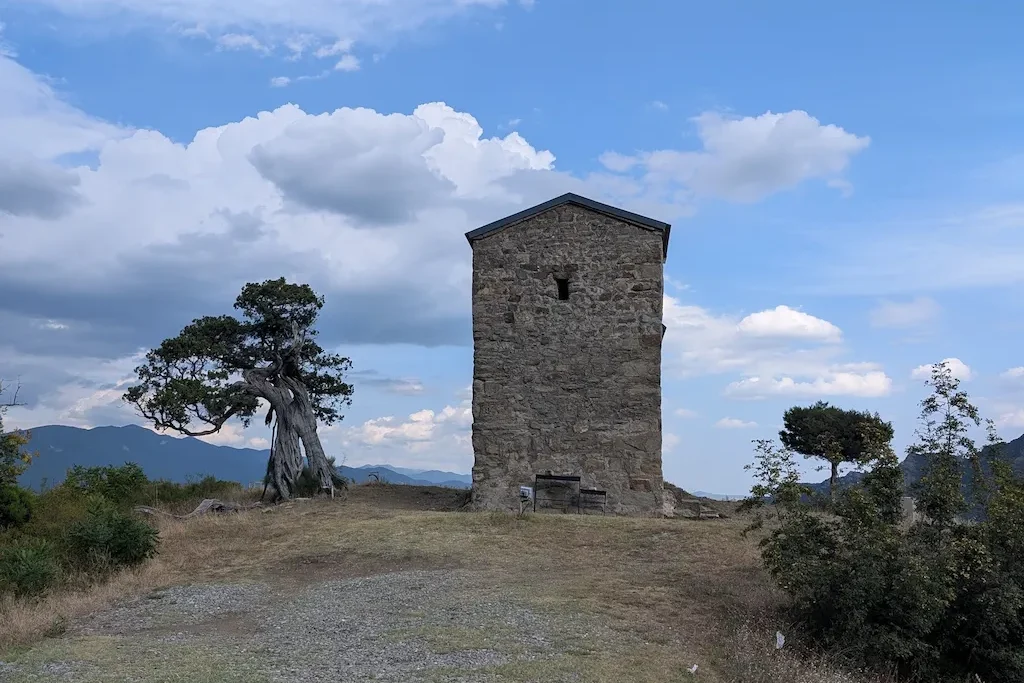
7. Kaloubani St George Church: A Small Church Above the Valley
➕ Optional stop
🚗 Driving time from Svetitskhoveli: allow about 40 minutes for the walk back to the car, drive, rough-road section and final approach
🛣️ Road conditions: rough, stony and uneven
🚶 Walk from the parking point: ~3–5 minutes
⏱️ Time at the viewpoint: 10 minutes
🚙 Vehicle: SUV or high-clearance crossover strongly recommended
After leaving Mtskheta, the route follows the winding road toward Shio Mghvime. Kaloubani St George Church, a small 12th-century church standing alone on a ridge, is an optional detour offering wide views across Mtskheta, the valley and the surrounding mountains.
Beside the church, a large, beautifully shaped juniper tree adds a special atmosphere to the setting and gives photographs taken here a distinctive character, making it a favorite among travelers.
📝 Allow about 10 minutes beside the church to take in the remarkable views of the surrounding mountains, valley and Mtskheta below, and to photograph its picturesque exterior. The door is likely to be locked, so plan this primarily as an outdoor stop.
⚠️ 🅿️ Use the exact parking point marked on the map. The final rise immediately below the church becomes much steeper and rougher.
⚠️ 🚙 From the turnoff, the road to the church is stony and uneven for about five minutes of driving. An SUV or high-clearance crossover is recommended.
➡️ Next stop: Shio Mghvime Monastery
8. Shio Mghvime Monastery: Churches and Caves Among the Cliffs
⭐ Main stop
🚗 Driving time from Kaloubani: ~25–30 minutes
🛣️ Road conditions: paved but winding
🚶 Walk from parking to the gates: 3 minutes
⏱️ Time at the monastery complex: 50 minutes
🅿️ Parking: use the large marked area below the monastery entrance
📅 Closing time: currently listed as 7:00 p.m.
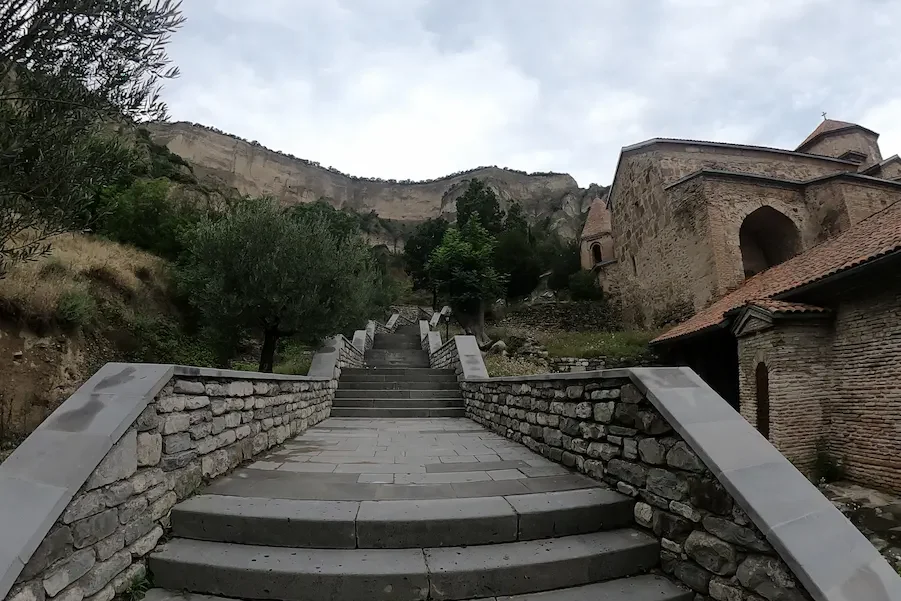
The road to Shio Mghvime winds away from Mtskheta into a narrow limestone landscape. Unlike Jvari or Kaloubani, the monastery does not offer a broad view over the surrounding mountains. Its beauty comes from the opposite effect: the complex is enclosed by pale cliffs, and the caves in the rock make the landscape feel inseparable from the history of the monastery.
The name Shio Mghvime means “the Cave of Shio.” Saint Shio was one of the group traditionally known as the Thirteen Assyrian Fathers, monks who came from Syria to strengthen Christian monastic life in 6th-century Georgia. After living near Mtskheta, Shio withdrew into this secluded valley.
The oldest surviving church in the monastery complex, dedicated to Saint John the Baptist, dates to the 560s–570s and was built during Shio’s lifetime. Its lower section is cut into the rock, reinforcing the connection between architecture and the natural cliff. The Dormition Church was commissioned by King David the Builder between 1103 and 1123, although invasion and later reconstruction changed its original form. The complex also includes a medieval refectory, later towers and monastic buildings.
Saint Shio spent the final years of his life in a cave around twelve meters deep and was buried there. The cave-tomb now lies beneath a later structure within the main monastery complex, and visitors can descend to it by a staircase when access is open. As the monastic community grew around Shio in the 6th century, other monks settled in the surrounding cliffs, carving small caves as cells where they lived and prayed. Look toward the rock faces behind and around the monastery and you can still see more than one hundred cave openings. These caves originally served as monastic cells; during later invasions, some also provided shelter.
Later centuries were far more turbulent. Shio Mghvime was repeatedly damaged during invasions, most notably during the campaigns of Shah Abbas I in the early 17th century, when the large church built under King David IV was destroyed. Further attacks and periods of decline followed before the monastery underwent extensive restoration in the 1890s.
📝 Visitors cannot drive into the monastery complex. Leave the car in the marked parking area and walk uphill for about three minutes to the gates. Allow roughly 40–50 minutes for the principal churches, Shio’s cave-tomb and the grounds.
⚠️ 🐄 The road to the monastery is paved and generally easy to drive, though it is winding in places. Cows and horses sometimes graze beside the road.
➡️ Next (optional): walk to St Shio’s First Hermitage Cave
Optional Walk: St Shio’s First Hermitage Cave
➕ Optional stop
🚶 Walking time from the parking area: ~5 minutes each way
⏱️ Time at the point: ~10 minutes
🛣️ Access: short roadside walk followed by a small uphill path
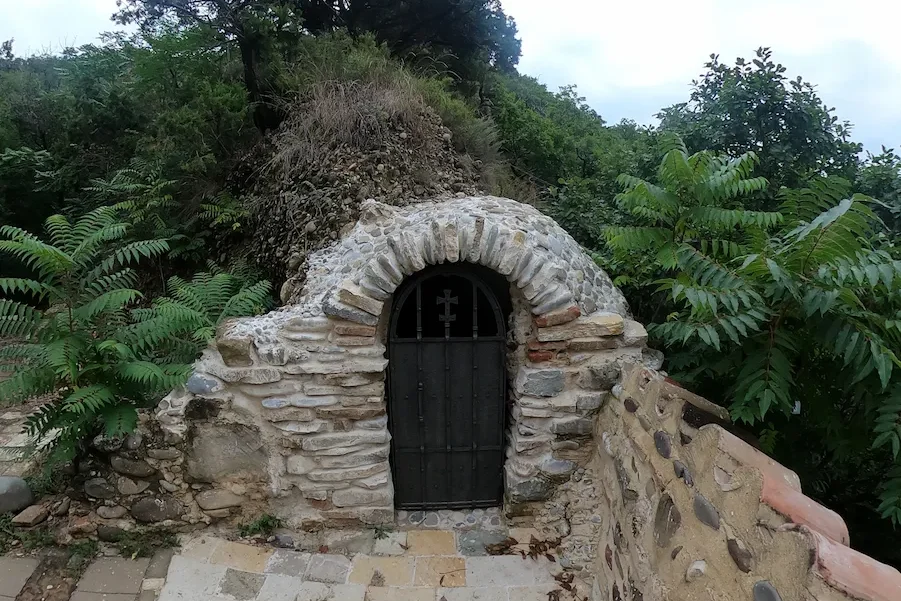
This map point marks the small cave where Shio is believed to have lived during his early period of solitude, before a growing number of followers formed a larger monastic community around him. According to accounts of his life, the Virgin Mary and Saint John the Baptist appeared to him here — an event reflected in the map point’s name, Appearance. A small church was later built directly above the cave.
The cave is very small and the visit is brief. Its interest lies in connecting the landscape with the beginning of Shio’s hermitage, not in seeing a large underground chamber. This is different from the saint’s deep final cave and burial place inside the main complex.
📝 From the main parking area, walk downhill, away from the monastery gates. Follow the side of the road for about three minutes, then turn left at the sign and take the short uphill path to the church and cave. The complete walk takes approximately 5 minutes each way, and traffic along the roadside section is generally light.
➡️ Next (optional): short hike up the hill to Church of the Exaltation of the Holy Cross
Optional Hike: Church of the Exaltation of the Holy Cross
➕ Optional stop
🚶 Walking time: ~15 minutes uphill each way
⏱️ Time at the church: ~20 minutes
🛣️ Access: steep, uneven hiking-style path
The Church of the Exaltation of the Holy Cross stands on the hill above the Shio Mghvime Monastery. It is a 12th-century single-nave church and is especially valuable for the fragments of medieval wall painting preserved inside. These are regarded as the oldest surviving paintings within the Shio Mghvime complex.
The name refers to the Christian Feast of the Exaltation of the Holy Cross, which commemorates the discovery and ceremonial elevation of the True Cross in Jerusalem.
Those who make the climb are rewarded with one of the best viewpoints of the day. The church occupies an exposed hilltop with an almost 360-degree panorama across the cliffs, wooded slopes and distant landscape. Many visitors make the ascent primarily for the view and photographs.
📝 Complete the main monastery first, then decide whether daylight, weather and energy make the climb sensible.
⚠️ The path is short but uneven and steep in places.
➡️ Next stop: dinner at Ornament Express
9. Dinner at Ornament Express
🍴 Dinner stop
🚗 Driving and parking time from Shio Mghvime: ~30 minutes
🛣️ Road conditions: paved and generally in good condition
⏱️ Time for dinner: 1 hour 20 minutes
🅿️ Parking: use any suitable legal space available nearby
📞 Reservation: recommended for a terrace table, especially on weekends
Return to Mtskheta for dinner at Ornament Express. The restaurant occupies a historic three-story Georgian house, which gives the meal a strong sense of place.
The menu includes Georgian dishes, desserts, qvevri and bottled wines, as well as some international options. Its signature feature, however, is the terrace view: Svetitskhoveli Cathedral fills the foreground, while Jvari Monastery can be seen on the hill beyond.
In good weather, request a terrace table. Weekday seating is often easier to find, but a reservation is still useful if the view is an important part of the plan. On weekends, on holidays and during the sunset period, booking ahead is the safer choice.
The suggested dinner slot from 7:10 to 8:30 p.m. provides enough time for a relaxed meal. Leaving at 8:30 p.m. should bring most travelers back to Tbilisi at around 9:00 p.m., depending on traffic and their final destination.
🏁 This is the final stop!
Suggested One-Day Itinerary and Timing
The following schedule assumes a 9:00 a.m. departure from central Tbilisi, normal traffic, and reasonably dry roads. The gaps between scheduled stops are intentional: they account for the full transition between stops, not just driving time, and include a practical buffer for parking, navigation, and small delays. Leaving each stop by the end time shown in the schedule will help keep the day on track.
| Time | Location | Time allocated | What the timing includes |
|---|---|---|---|
| Travel from Tbilisi 🚗 | |||
| 9:00 a.m. | Leave Tbilisi | 45–60 min | Drive to Jvari with a small traffic and parking buffer |
| Jvari and Arrival in Mtskheta ⛪ | |||
| 10:00–10:40 a.m. | Jvari Monastery | 40 min | Monastery, exterior and main panorama |
| Mtskheta City 🏛️ | |||
| 11:00–11:10 a.m. | Pompey Bridge | 10 min | Short optional roadside view |
| 11:20 a.m.–12:00 p.m. | Samtavro Monastery | 40 min | Main church, St Nino’s Church and grounds |
| 12:15–1:30 p.m. | Lunch at Check-In Garden | 1 hr 15 min | Time for a relaxed lunch |
| 1:50–2:30 p.m. | Mtskheta Old Town | 40 min | Streets, market stalls and souvenir shops |
| 2:40–3:20 p.m. | Svetitskhoveli Cathedral | 40 min | Interior, courtyard and exterior details |
| Road to Shio Mghvime 🏔️ | |||
| 4:00–4:10 p.m. | Kaloubani St George Church | 10 min | Optional panorama and exterior of the church |
| 4:40–6:40 p.m. | Shio Mghvime area | 2 hrs | Main monastery plus one or both optional walks |
| Dinner & Back to Tbilisi 🍽️ | |||
| 7:10–8:30 p.m. | Dinner at Ornament Express | 1 hr 20 min | Dinner and terrace views |
| 9:00 p.m. | Approximate arrival in Tbilisi | — | End of route |
FAQ: How to Prepare for This Trip
Can This Mtskheta Day Trip Be Done Without a Car?
The main sights in central Mtskheta can be explored on foot, and some travelers take a taxi from Mtskheta to Jvari Monastery. However, renting a car is the most convenient way to complete the full route, particularly if you plan to continue to Shio Mghvime.
Shio Mghvime lies outside Mtskheta, so arranging a taxi back to town may take time. Taxi drivers may also refuse to take the rough, stony road to Kaloubani St George Church.
Do I Need an SUV for This Route?
No, not for the main route. In normal conditions, an ordinary passenger car is sufficient for Jvari, central Mtskheta and Shio Mghvime. The highways around Tbilisi and Mtskheta are paved. The road to Shio Mghvime is also paved, although it is narrow and winding in places.
An SUV or high-clearance crossover is recommended for the optional detour to Kaloubani St George Church. A low front bumper, long wheelbase or limited ground clearance can make the five-minute drive on the rough, stony road difficult. Four-wheel drive can be helpful, but good ground clearance is more important.
For renting a car in Georgia, consider Localrent, which focuses on selected local rental companies and transparent rental terms, or GetRentacar, a marketplace where rental companies and private owners submit competing offers.
If you plan to include Kaloubani, confirm before booking that the rental agreement permits driving on its unpaved road.
What Should I Wear at Georgian Monasteries?
Jvari, Samtavro, Svetitskhoveli and Shio Mghvime are active religious sites. Wear clothing that covers shoulders and knees. Long pants are the simplest choice for men. Women may also be asked to cover their hair; communal scarves and wraps are sometimes available, but carrying a light scarf is more convenient and hygienic.
How Should I Plan Dinner Around Sunset?
To enjoy the golden-hour light and sunset during dinner, use these approximate starting times:
- Late April through August: 7:10 p.m. In June and July, plan to stay until approximately 8:45 p.m.
- Early to mid-April and September: 6:30 p.m.
- March: 6:00 p.m.
- February and October: 5:30 p.m.
- November through January: 5:00 p.m.
When planning dinner before 7 p.m., leave Tbilisi at 8:00 a.m. instead of 9:00 a.m. and skip optional stops as needed. In winter, snow, ice, and limited daylight may make some optional stops impractical even with the earlier departure.
Which Optional Stop Is Most Worth Keeping?
The best choice depends on your interests and available time:
- Easiest to fit into the schedule — Pompey Bridge and St Shio’s First Hermitage Cave: both stops add little time to the itinerary and are easy to reach from the planned route.
- Best panoramic view — Church of the Exaltation of the Holy Cross: a short uphill walk leads to one of the widest panoramas on the route.
- Best for an atmospheric church setting — Kaloubani St George Church: an isolated hilltop church surrounded by mountain scenery, best reached in an SUV or high-clearance crossover.
Why This Tbilisi to Mtskheta Day Trip Is Worth a Full Day
A day trip to Mtskheta brings together panoramic landscapes, UNESCO-listed monuments, the story of Georgia’s conversion to Christianity and secluded monasteries surrounded by cliffs and caves. Beginning at Jvari allows you to see the city from above before exploring the places that shaped its history.
With a 9:00 a.m. departure, there is enough time for unhurried sightseeing and two relaxed meals. Dinner overlooking Jvari and Svetitskhoveli brings the journey full circle and creates a memorable ending to the day.
If you would like to learn more about Tbilisi and discover interesting places in the capital, see the Tbilisi Travel Guide.
Useful Links & Official Sources
The following official resources provide further information about Mtskheta and the historic monuments included in this route.
Mtskheta on Georgia’s Official Tourism Website:
https://georgia.travel/cities-towns/mtskheta
The official guide to Mtskheta, covering the city’s history, religious significance, UNESCO-listed monuments, Old Town and nearby monasteries.
UNESCO — Historical Monuments of Mtskheta:
https://whc.unesco.org/en/list/708/
The official UNESCO World Heritage listing for Mtskheta’s historical monuments, including Jvari Monastery, Svetitskhoveli Cathedral and Samtavro Monastery.
Travel Planning Tools
The Best Way to Find Flights to Tbilisi:
https://aviasales.ge
A comprehensive and user-friendly platform to search for flights, compare direct routes from various airlines, and securely book your travel to Tbilisi.
Car Rental Options in Georgia:
Localrent or GetRentacar
Localrent focuses on selected local rental companies and clearly presented rental terms, while GetRentacar lets travelers compare offers from rental companies and private owners.